01302 246818

Why Are Collaborative Robots Used in Manufacturing?

Why Are Collaborative Robots Used in Manufacturing?

Collaborative robots, or cobots, are designed to work near people on suitable production tasks. Their appeal is practical: they can handle repeated movements while workers manage judgment, setup, and changing priorities. In a small assembly cell, a cobot might lift a component, hold it steady, or fasten screws beside an operator. The goal is not simply to add a robot. It is to make a particular task safer, steadier, or less repetitive.

Robotics researchers Michael Peshkin and J. Edward Colgate described a cobot as “a device which manipulates objects in collaboration with a human operator.” That definition points to the central idea: people and machines share parts of a workflow. In collaborative robots in manufacturing, this can help teams address repetitive handling, support consistent cycle times, and adapt automation to varied production needs. A compact arm may also fit into a workstation where a larger industrial robot would be impractical. But “collaborative” does not mean every robot can safely work beside every person. Risk assessment, appropriate equipment, and careful cell design still matter.

The benefits are real, but they are not automatic. A cobot may reduce strain during repeated handling, yet poor task design can simply move the burden elsewhere. Workers need training. The process needs testing. And sometimes a simple fixture or workflow change works better. That is worth admitting. Manufacturers use cobots when human skill and repeatable machine movement complement each other—not because automation is a cure for every production problem.
Why Are Collaborative Robots Used in Manufacturing?

What Collaborative Robots Are and How They Differ from Industrial Robots

A collaborative robot, or cobot, is designed for work that may involve people and robots sharing a workspace. It is still an industrial robot; “collaborative” describes how the robot is designed and used, not a separate, risk-free machine category. The International Federation of Robotics reported 541,302 industrial robot installations worldwide in 2023 (World Robotics 2024). That figure includes many kinds of robots, so it should not be read as a cobot count.

Traditional industrial robots often perform fast, repetitive tasks inside guarded cells. Cobots may instead assist with jobs such as placing parts in a tray while a worker checks alignment. They commonly include features such as force sensing, speed limits, or hand-guiding controls. But a safety feature alone does not make a work cell safe. Not automatically safe. The robot, tool, part, and task all affect risk; a sharp tool or heavy workpiece can change the picture.

ISO/TS 15066 provides guidance for collaborative robot applications, including force and pressure considerations. In practice, manufacturers and integrators still need to assess the full setup and verify protective measures. The boundary between “cobot” and conventional robot can be less clear than it sounds. A cobot may need guarding when its task, speed, or surroundings create hazards.

How Collaborative Robots Work Alongside Human Operators

Collaborative robots, often called cobots, are designed to share work areas with people when the task and safeguards allow it. They may hold a component steady, feed a fixture, or repeat a fastening motion while an operator checks alignment and quality. They don’t replace judgment. A technician can spot a rough edge, reposition a part, or pause the cell when something feels wrong.

Before work begins, teams map the task and identify pinch points, sharp edges, moving tools, and unexpected starts. Sensors and configured limits can reduce risk, but they do not make every setup automatically safe. The actual risk depends on the robot, tool, workpiece, layout, and how quickly someone may enter its path. Some operations may still need guards or physical separation.

During production, people often handle exceptions, material changes, and visual checks, while the robot performs steady, repetitive motions. Clear handoff points matter. A tray should sit within reach, cables should stay out of walkways, and controls should be easy to access. Training should cover normal stops, recovery steps, and who can restart equipment. It takes practice. Even a carefully planned cell can feel awkward at first; operators may notice reach or timing problems that designers missed. Their feedback should prompt adjustments, not be dismissed as resistance.

Why Are Collaborative Robots Used in Manufacturing? — How Collaborative Robots Work Alongside Human Operators
Manufacturing task Human operator’s role Collaborative robot’s role How they work together Why a collaborative robot is used Important operating considerations
Machine tending Loads or replenishes parts, checks finished components, and responds to process issues. Transfers parts between a fixture and a machine, or places them into a defined work area. The operator and robot may share a work area, with access coordinated through the cell’s safety system. Automates repetitive transfers while allowing an operator to oversee the machine and handle exceptions. Machine access, door interlocks, stopping time, robot reach, and the risk assessment determine whether additional guarding is needed.
Assembly assistance Aligns components, makes judgments about fit, and completes steps requiring dexterity or product knowledge. Holds a part or tool, presents components, or performs a repeatable fastening or insertion step. The robot can present parts for the operator or perform a step after the operator confirms the assembly is ready. Reduces repetitive handling and can support consistent positioning without removing the operator’s role in quality decisions. Tooling, pinch points, sharp edges, and the parts being handled must be considered in the application risk assessment.
Packaging and case loading Supplies materials, checks labels or product condition, and manages changes in packaging requirements. Places products into trays or boxes and repeats programmed pick-and-place movements. People replenish packaging materials and supervise the process while the robot performs repetitive placement. Helps manage repetitive motions and maintain a steady workflow, particularly where product presentation is predictable. Actual throughput depends on the product, gripper, layout, cycle sequence, and safety limits; it is not a fixed cobot capability.
Inspection and testing Reviews results, handles borderline cases, and decides how defects or process deviations should be addressed. Positions parts or a measurement tool consistently, or moves items through a repeatable test sequence. The operator interprets results and manages exceptions while the robot handles routine positioning or transfer. Can make repetitive inspection handling more consistent and free the operator to focus on judgment-based checks. Measurement accuracy depends on the inspection equipment, calibration, fixture design, and process—not on the robot alone.
Repetitive screwdriving Feeds parts, checks the joint or completed assembly, and addresses incorrect or incomplete results. Positions a powered driver and follows a programmed fastening sequence. The operator can stage parts while the robot performs repeatable fastening at an agreed workstation. Reduces repeated tool handling and helps standardize tool position and sequence. Fastener control, tool reaction forces, access to the workpiece, and the consequences of a missed fastener require assessment.
Operator-guided positioning Guides the robot or workpiece into position and applies process knowledge to set up a task. Moves along a guided path or supports a load under the configured control method. In hand-guiding applications, an operator can guide the robot using an enabling device or approved interface. Can make certain setup or positioning tasks easier to repeat while keeping the operator directly involved. Hand guiding is a defined collaborative operation, not permission for unrestricted contact; the specific system and procedure must be validated.

Collaborative operation is determined by the complete application, not by the robot alone. Common approaches include safety-rated monitored stop, hand guiding, speed and separation monitoring, and power and force limiting. A risk assessment is required to select protective measures; some applications still need guarding or other access controls.

Which Manufacturing Tasks Are Suited to Collaborative Robots

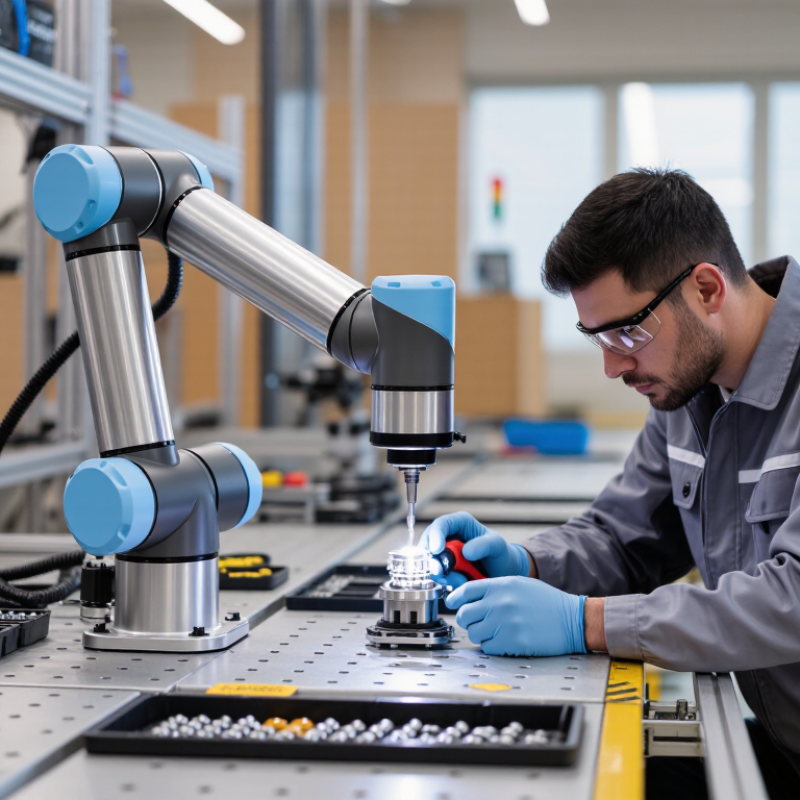
Collaborative robots are best suited to manufacturing tasks that are repetitive, physically tiring, or precise but not highly variable. They can load parts into machines, move components between workstations, and handle simple assembly steps. A typical example is placing small metal pieces into a fixture, then moving each finished part to a tray. The cycle is steady. The operator can focus on inspection or adjustments.

These robots also work well for screwdriving, dispensing sealant, and basic quality checks when parts and processes are consistent. A worker might position a product while the robot tightens fasteners, reducing repeated wrist movements. This pairing can help, but it does not make every task safer by itself. Reach, tool speed, sharp edges, and unexpected contact all need careful assessment. That boundary is easy to underestimate.

Material handling is another practical fit, especially when boxes or components are manageable and arrive in predictable positions. Tasks requiring delicate judgment, frequent design changes, or highly irregular parts may need more human involvement. Teams should test the actual workstation, not just a demonstration setup. Observe cycle time, awkward reaches, and where workers still need to intervene. A measured pilot often reveals small problems, like a bin placed just outside comfortable reach.

Why Are Collaborative Robots Used in Manufacturing?

Typical task suitability for collaborative robots

Repetitive, predictable tasks such as machine tending, pick-and-place, and inspection are often good candidates for cobots. Ratings are a qualitative comparison based on task characteristics, not measured industry adoption or a safety certification. Actual suitability depends on a task-specific risk assessment, payload, tooling, cycle time, and workspace.

What Benefits Collaborative Robots Bring to Manufacturing

Collaborative robots can handle repetitive tasks such as loading a machine, placing components, or tightening fasteners. This may reduce awkward reaching and repeated lifting during a shift. A small improvement. Workers can spend more time on inspection, problem-solving, and adjustments that require human judgment.

Flexibility A cobot can often be moved between workstations and configured for a different product run. For factories with frequent changeovers, this may make automation possible without rebuilding an entire production line. Setup still takes planning: tooling, cycle time, workspace, and worker movement all matter. A robot waiting for parts will not improve output.

Cobots can also perform repeated motions consistently, helping reduce variation in tasks such as placing or fastening parts. Sensors and suitable safety measures may allow them to work near people. Collaborative does not mean risk-free. Every application needs a task-specific risk assessment, clear procedures, and worker training. Some processes also require more speed or payload than a cobot can provide, a trade-off that can be easy to miss when a demonstration looks smooth.

What Safety and Integration Factors Shape Their Use

Collaborative robots can work near people, but proximity alone does not make a cell safe. A risk assessment should examine the task, tool, workpiece, and nearby hazards. A light robot arm may still pinch fingers against a fixture, while a sharp tool can create risks beyond the arm’s motion. Safety settings need to match real operating conditions, not just a demonstration.

People matter. Integrators should test stop behavior, reach, speed, and force with the actual end effector and payload. A worker reaching across the cell may change the risk picture. Guards, scanners, or separation zones may still be necessary, depending on the application. Small details matter. Clear work instructions and practical training help operators recognize when a process has changed or needs attention.

Integration also shapes whether a robot helps or disrupts production. It must communicate reliably with the machine, sensors, and control system, while fitting the available floor space and cycle time. Cable routing, part variation, and tool changes can cause problems that a clean simulation misses. Maintenance access is easy to overlook. In one cell, a minor fixture adjustment may improve reach but create a new pinch point; teams should reassess the setup after such changes. The first design is rarely perfect, and careful observation during real shifts can reveal what needs refinement.