
Why Choose Robotics Engineering Courses for Your Career?
Choosing robotics engineering courses can open a practical path into automation, intelligent machines, and advanced manufacturing. These programs combine mechanical design, electronics, programming, control systems, and artificial intelligence. Students may begin with a simple sensor circuit, then progress toward robotic arms, mobile platforms, or autonomous vehicles. The learning curve is real. That challenge is part of the value.
Daniela Rus, director of MIT’s Computer Science and Artificial Intelligence Laboratory, has said, “Robots are not going to replace humans; they are going to augment humans.” Her observation reflects the changing role of robotics engineers. Modern workplaces need professionals who can design safe systems, test machine behavior, interpret data, and cooperate with people. Robotics engineering courses develop these abilities through laboratory work, simulation software, group projects, and industry-based problems.
A strong course should offer more than impressive equipment. Students need mathematics, physics, embedded programming, computer vision, and ethical decision-making. They should also learn how to document failures clearly. A robot that stops beside a painted line may reveal a calibration problem, not a career-ending mistake. Small errors teach important lessons.
Still, no course guarantees success. Learners must practice beyond scheduled classes and keep updating their technical knowledge. They may need to rebuild the same mechanism several times. That can feel frustrating. It is also realistic preparation for engineering work, where reliability comes from repeated testing, careful measurement, and honest reflection. For students who enjoy solving tangible problems, robotics engineering courses can connect classroom theory with machines that operate in the real world.
What Robotics Engineering Involves
Why Choose Robotics Engineering Courses for Your Career?
What Robotics Engineering Involves
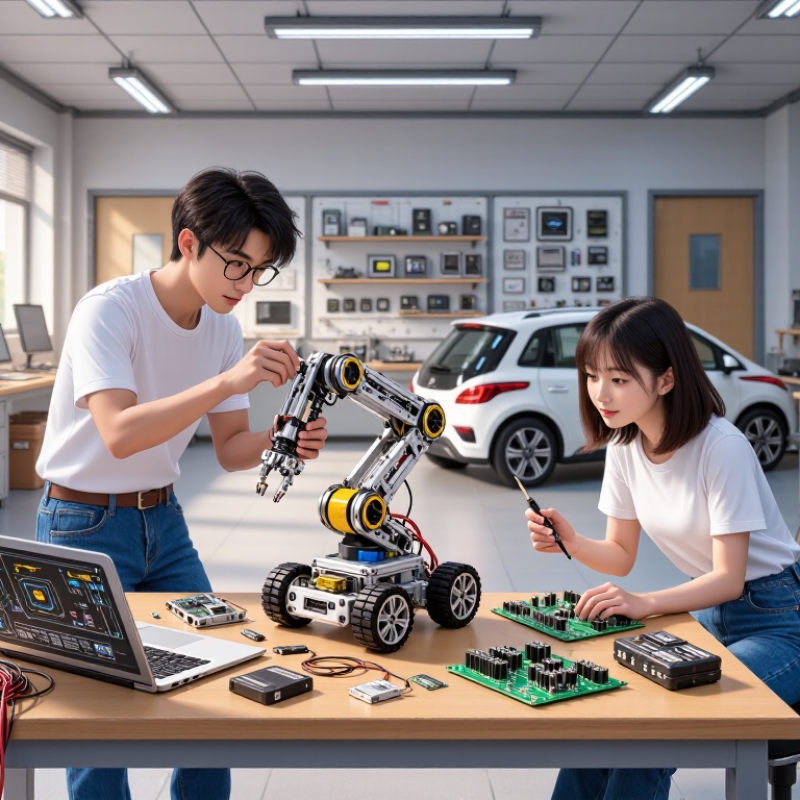
Robotics engineering combines mechanical design, electronics, computer programming, and intelligent control. A student may design a robotic arm, wire its sensors, and write code for accurate movement. The work is practical. Metal joints, loose cables, and noisy motors often reveal problems faster than theory.
Courses usually cover kinematics, embedded systems, control theory, computer vision, and manufacturing methods. You may use mathematics to calculate joint angles, then test those calculations on a physical machine. Small errors matter. A few millimeters can make a gripper miss its target. Reliable engineers document tests, check measurements, and consider safety before improving performance.
Tips: Build simple projects. Start with a sensor and motor. Keep a test log. Ask why a system failed, not only how to repair it. Teamwork also matters because mechanical and software decisions affect each other. I once underestimated cable placement in a prototype, and the moving joint pulled it loose. That mistake changed my testing habits. However, technical confidence should not become careless confidence. Robotics still requires patience, ethical judgment, and respect for people working near automated equipment.
Why Choose Robotics Engineering Courses for Your Career? - What Robotics Engineering Involves
| Dimension | What It Involves | Typical Learning or Career Value |
|---|---|---|
| Core Definition | The integration of mechanical engineering, electrical engineering, electronics, control systems, and computer science to design and operate robots. | Builds a multidisciplinary foundation for developing complete robotic systems rather than focusing on only one engineering component. |
| Mechanical Design | Designing frames, joints, gear systems, actuators, end-effectors, and mechanisms that allow a robot to move and perform tasks. | Develops skills in mechanics, materials, computer-aided design, prototyping, and design-for-manufacture principles. |
| Electronics and Embedded Systems | Connecting sensors, motors, power systems, microcontrollers, and communication interfaces so robotic hardware can receive and act on information. | Provides practical experience with circuits, signal processing, embedded programming, testing, and hardware integration. |
| Programming and Software | Writing programs that control motion, process sensor data, manage robot behavior, and connect hardware with software systems. | Strengthens computational thinking and commonly introduces languages and environments used for robotics, such as C/C++-style programming, Python, and robotic middleware. |
| Control Engineering | Using mathematical models and feedback to make a robot move accurately, remain stable, and respond to changing conditions. | Develops knowledge of system dynamics, feedback loops, trajectory planning, calibration, and motion control. |
| Perception and Computer Vision | Enabling robots to interpret their environment using cameras, depth sensors, force sensors, proximity sensors, and other measurement devices. | Supports work in object detection, localization, mapping, inspection, navigation, and human–robot interaction. |
| Artificial Intelligence and Autonomy | Applying planning, machine learning, data analysis, and decision-making methods to help robots perform tasks with limited human intervention. | Prepares learners for increasingly autonomous systems while emphasizing data quality, validation, safety, and responsible deployment. |
| Hands-On Project Work | Building, programming, testing, and improving robots through laboratory exercises, simulations, prototypes, and team-based projects. | Creates evidence of practical ability and teaches debugging, documentation, project planning, and iterative engineering. |
| Safety and Human Factors | Assessing hazards, limiting unsafe motion, designing protective measures, and considering how people interact with robotic systems. | Builds awareness of risk assessment, safe operating procedures, usability, accessibility, and ethical engineering practice. |
| Common Application Areas | Manufacturing, logistics, agriculture, healthcare, research, inspection, construction, environmental monitoring, and domestic or service applications. | Offers transferable skills that can be applied across multiple sectors and technical work environments. |
| Typical Career Roles | Robotics engineer, automation engineer, controls engineer, mechatronics engineer, embedded systems engineer, computer vision engineer, or robotics software developer. | Provides several career directions, allowing graduates to specialize in hardware, software, controls, perception, integration, or research. |
| Transferable Professional Skills | Problem-solving, systems thinking, technical communication, teamwork, experimentation, data interpretation, and project coordination. | Improves effectiveness in interdisciplinary teams where engineers must connect mechanical, electrical, software, and operational requirements. |
| Career Preparation | Combining theory with laboratory practice, design reviews, simulation, system testing, and technical documentation. | Helps learners demonstrate both engineering knowledge and the practical ability to develop, evaluate, and improve robotic systems. |
Note: Course content varies by institution and qualification level; programs may place different emphasis on hardware, software, automation, artificial intelligence, or research.
Related Posts
-
What is Robotics Engineering Courses and How to Choose the Right One
-

Unlocking Productivity Gains with Robotic Process Automation Software Insights and Trends for 2024
-
What is a Robot Machine and How Does It Work?
-

10 Best Robotics Automation Trends Transforming Industries in 2023
-
Unlock Your Future with Innovative Robotics Engineering Courses for Aspiring Engineers
-

How to Implement Effective Automation Systems for Your Business?