
China Top 10 Advanced Robotics Suppliers for Global Buyers?
China has become a central market for advanced robotics, supported by strong manufacturing demand and expanding automation investment. The International Federation of Robotics reported 276,288 industrial robot installations in China during 2023. This represented about 51% of global installations. China also reached approximately 470 robots per 10,000 manufacturing employees, according to the IFR World Robotics 2024 report.
The scale is impressive. The details matter more. Global buyers must examine payload, repeatability, operating speed, software compatibility, safety functions, and after-sales support. A robotic arm may look efficient in a demonstration, yet perform differently beside welding sparks, warehouse dust, or fast-moving packaging lines. Interact Analysis has also identified China as the world’s largest industrial robot market, with domestic suppliers gaining ground against established international brands. That shift creates more choice, but it can complicate supplier evaluation.
This introduction frames ten leading Chinese suppliers for international purchasing teams. The selection considers industrial robots, collaborative robots, autonomous mobile robots, machine vision, system integration, export experience, and technical support. It also considers real deployment evidence rather than marketing claims alone. Rankings are not absolute. They may change by application, budget, region, and service expectations. That limitation deserves attention.
Some suppliers excel in automotive welding. Others are stronger in electronics assembly, palletizing, logistics, or healthcare automation. Buyers should request verified case studies, lifecycle costs, certification documents, spare-parts plans, and local maintenance arrangements. The strongest choice is rarely the cheapest quotation. It is the supplier that can keep a production cell stable after installation. That is where many comparisons remain imperfect.
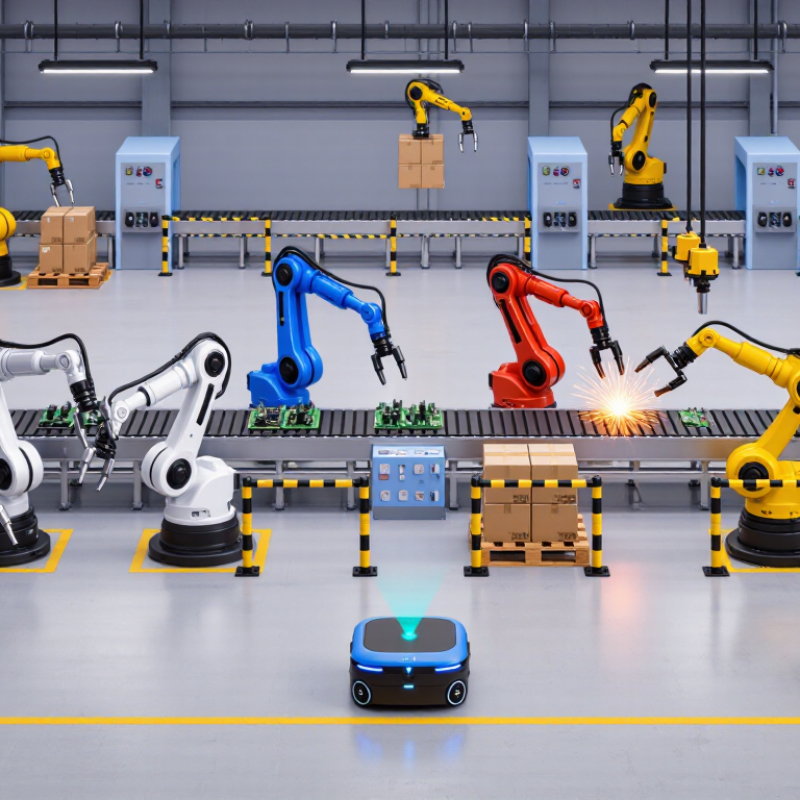
China’s Robotics Market: 276,288 Industrial Robots Installed in 2023
China installed 276,288 industrial robots in 2023, according to the International Federation of Robotics’ World Robotics 2024 report. This represented over half of global installations, despite a year-on-year decline of about 5%. The figure shows substantial demand, but it also signals a more selective market. Buyers now examine lifecycle value, not only purchase price.
For global buyers, China’s advanced robotics suppliers typically compete across articulated robots, SCARA systems, autonomous mobile robots, machine vision, and factory software. A practical evaluation should cover payload accuracy, cycle-time stability, spare-parts access, safety certification, cybersecurity, and integration support. A robot moving metal parts beside a press may look efficient, yet poor guarding or delayed maintenance can stop an entire production cell. Small details matter.
The IFR also reported that China’s operational industrial robot stock reached approximately 1.755 million units in 2023. This installed base creates valuable field experience, but the number alone does not prove supplier quality. Buyers should request verified uptime records, reference installations, training plans, and total-cost estimates over five years. I would also question optimistic productivity claims. Real factories face dust, uneven workpieces, changing operators, and software updates. Laboratory performance is not production performance. Supplier rankings can guide research, but they should never replace site audits and technical trials.
China Top 10 Advanced Robotics Suppliers for Global Buyers? – China’s Robotics Market: 276,288 Industrial Robots Installed in 2023
Anonymous supplier capability matrix for international procurement comparison; company and brand names are intentionally excluded.
| Rank | Anonymous Supplier Profile | Primary Robotics Segment | Typical Payload Range | Key Application Strength | Export-Readiness Indicators | Recommended Buyer Type | Due-Diligence Priorities |
|---|---|---|---|---|---|---|---|
| 1 | Supplier Profile A | Six-axis articulated robots | 6–500 kg | Automotive welding, material handling, machine tending and palletizing | Multi-language documentation, overseas service partners and configurable safety options | Automotive manufacturers, Tier-1 suppliers and system integrators | Repeatability, controller compatibility, safety certification and spare-parts availability |
| 2 | Supplier Profile B | SCARA robots | 1–20 kg | Electronics assembly, screwdriving, dispensing, testing and high-speed pick-and-place | Standardized product families, English software interface and remote commissioning support | Electronics, electrical equipment and precision assembly buyers | Cycle-time validation, positional repeatability, vision integration and software localization |
| 3 | Supplier Profile C | Collaborative robots | 3–20 kg | Small-batch assembly, packaging, inspection and flexible production cells | Risk-assessment documentation, quick-change tooling support and low-code programming | SMEs, contract manufacturers and manufacturers with frequent product changes | ISO 10218 and ISO/TS 15066 alignment, force limits, cybersecurity and training |
| 4 | Supplier Profile D | Delta and parallel robots | 0.5–15 kg | Food, pharmaceutical and consumer-goods sorting, picking and packing | Hygienic design options, stainless-steel configurations and washdown-compatible solutions | Food processors, medical-product manufacturers and high-throughput packers | IP rating, cleanability, food-contact materials and sustained cycle-rate testing |
| 5 | Supplier Profile E | Heavy-payload robots | 100–800 kg | Foundry handling, forging, casting, welding and large-part palletizing | High-load product range, ruggedized options and integration support for harsh environments | Metalworking, construction machinery and industrial component producers | Thermal resistance, ingress protection, foundation loads and maintenance intervals |
| 6 | Supplier Profile F | Welding and fabrication robots | 6–300 kg | Arc welding, laser processing, cutting and metal fabrication | Support for international welding power sources, offline programming and process libraries | Steel fabrication shops, machinery manufacturers and automotive component suppliers | Weld-quality consistency, torch calibration, seam tracking and consumable compatibility |
| 7 | Supplier Profile G | Palletizing and packaging systems | 50–300 kg | Case packing, bag handling, palletizing and depalletizing | Pre-engineered cells, regional integrator network and support for common warehouse interfaces | Logistics, beverage, chemical and consumer-goods manufacturers | Throughput at full payload, pallet-pattern flexibility, safety-cell design and uptime data |
| 8 | Supplier Profile H | Machine-tending robots | 5–100 kg | CNC loading, unloading, deburring, inspection and multi-machine tending | Flexible gripper packages, common CNC communication options and application engineering | Machining companies, metal-parts suppliers and industrial equipment makers | Door and chuck interfaces, chip protection, fixture repeatability and cell changeover time |
| 9 | Supplier Profile I | Vision-guided robotics | 1–100 kg | Random bin picking, quality inspection, orientation and traceability operations | Camera and sensor integration, 2D/3D vision support and application testing services | Electronics, automotive components and mixed-product manufacturers | Recognition accuracy, lighting tolerance, data handling, latency and false-rejection rates |
| 10 | Supplier Profile J | Mobile and intralogistics robots | 300–2,000 kg | Warehouse transport, line-side delivery, order movement and internal logistics | Fleet-management software, navigation mapping and warehouse-system integration options | Factories, distribution centers and smart-warehouse operators | Navigation reliability, fleet scalability, battery life, traffic management and cybersecurity |
| Market reference: China installed 276,288 industrial robots in 2023, accounting for approximately 51% of global installations according to the International Federation of Robotics’ World Robotics reporting. China’s installed operational stock exceeded 1.7 million industrial robots in 2023. Supplier rankings and company-level commercial claims should be independently verified through technical audits, sample testing, certification checks and reference-site visits before purchase. | |||||||
Related Posts
-
How to Implement Robotics Automation in Your Supply Chain?
-
10 Best Robotic Systems for Global Buyers?
-

Unlocking the Future of Work with Robotics and Automation Trends and Innovations in 2023
-

What is Robotics and Automation Driving the Future of Industry with 25 Percent Growth by 2025
-
2025 How to Choose the Right Collaborative Robot Arm for Your Business
-

2026 Best Robotic Systems Innovations to Transform Industries?