
01302 246818

Why Choose a Manual Ceramic Coffee Grinder for Wholesale?

For wholesale buyers, selecting the right grinder affects product quality, customer satisfaction, and long-term costs. A Manual Ceramic Coffee Grinder offers a practical option for retailers, cafés, travel brands, and hospitality suppliers. Its ceramic burrs resist rust and can provide a clean grinding experience when properly designed.

In my experience, buyers should examine more than the appearance. Burr alignment, handle strength, capacity, and adjustment control influence daily performance. A stable grinder should feel balanced on a countertop, while its handle should turn smoothly without excessive resistance. Ceramic burrs can produce consistent grounds, but results still depend on calibration and user technique. Small details matter.

Manual grinding takes time.

For wholesale purchasing, sample testing is essential. Compare grind consistency, noise, packaging quality, and cleaning requirements across several units. Ask suppliers for material specifications, food-contact information, production records, and quality-control procedures. Reliable manufacturers should explain their inspection process clearly, rather than relying on attractive product photos. Order quantities, replacement parts, branding options, and shipping protection also deserve careful review.

However, this product is not perfect for every market. Manual models may feel slow in busy cafés, and ceramic components can chip if dropped or poorly packed. That limitation should be stated honestly. A thoughtful wholesale decision balances price, durability, user expectations, and after-sales support. With careful evaluation, a Manual Ceramic Coffee Grinder can become a dependable addition to a focused coffee product range.
Why Choose a Manual Ceramic Coffee Grinder for Wholesale?

What Is a Manual Ceramic Coffee Grinder?

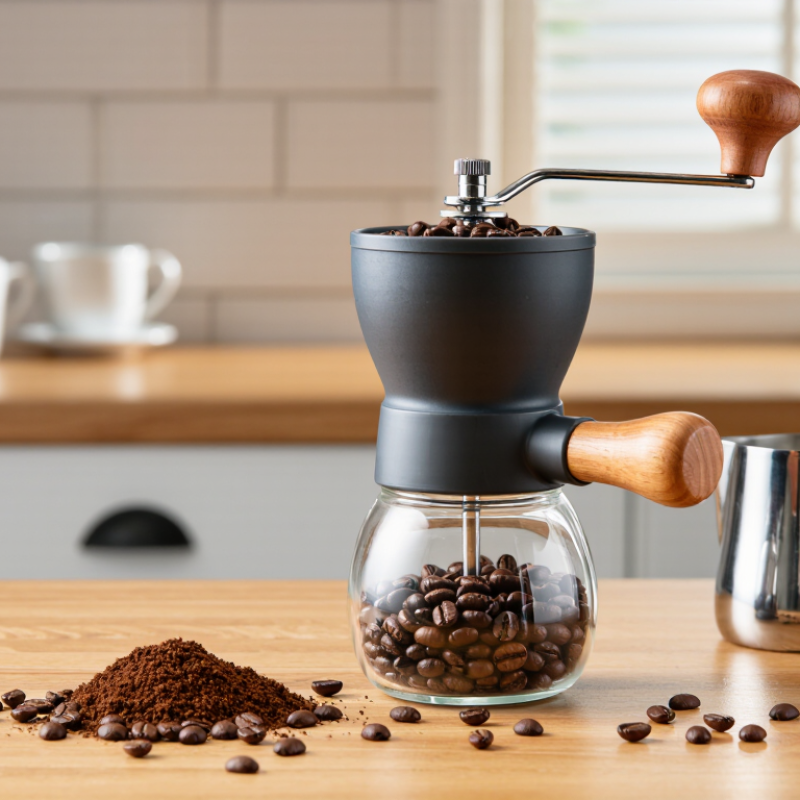
A manual ceramic coffee grinder is a hand-powered device that crushes roasted beans between two ceramic burrs. Unlike blade grinders, it creates a more consistent particle size. The user turns a crank, while an adjustable burr gap controls the grind, from fine espresso powder to coarse French press particles. No battery or power outlet is required.

The ceramic burr matters. It resists rust and transfers little heat during normal hand grinding. This can protect delicate aromas, although the difference is often overstated. Ceramic is also brittle. A dropped grinder may chip, and hard debris can damage the burr. Grinding usually takes several minutes. That feels slow in a busy café or warehouse.

Demand still supports practical wholesale products. The International Coffee Organization estimated global coffee consumption at 177.9 million 60-kilogram bags in 2023/24. The 2024 National Coffee Data Trends report also found that 67% of American adults drank coffee the previous day. These figures suggest a large audience for accessible brewing tools. However, volume alone does not guarantee repeat orders. Wholesalers should inspect burr alignment, handle strength, adjustment clarity, and spare-part availability. A compact ceramic grinder can suit travel kits, offices, and outdoor brewing. It may disappoint heavy users who expect electric speed. That limitation should be stated clearly.

How Does a Ceramic Burr Grinder Work?

How does a ceramic burr grinder work?

Two textured burrs crush coffee beans between them. One burr stays fixed, while the other turns with the hand crank. Adjusting the burr gap changes the grind size, from coarse particles for French press to finer particles for espresso. Ceramic resists rust and usually transfers less heat than steel during slow grinding. However, it can chip if dropped. That limitation matters in wholesale purchasing.

Demand for reliable brewing equipment remains strong. The National Coffee Association’s Spring 2024 National Coffee Data Trends report found that 67% of American adults drank coffee during the previous day. For cafés, offices, and hospitality suppliers, repeatable grinding can support more consistent extraction. A manual ceramic grinder also needs no electricity, which helps in mobile service or emergency preparation. Still, it is not automatically precise. Hand speed, bean hardness, and user technique can change the result. This is where experience becomes important. A grinder may look durable, yet its adjustment mechanism deserves careful testing.

Tips: Check burr alignment before bulk orders. Grind ten grams, then inspect the particles visually. Excessive dust may create bitterness. Clean the burrs regularly, but avoid soaking ceramic parts. Ask suppliers for replacement burr availability and tolerance information. Wholesale buyers should also test several users, because one operator’s “fine” setting may not match another’s.

Why Choose Ceramic Grinders for Wholesale Purchasing?

Ceramic grinders are a practical choice for wholesale purchasing because their burrs resist rust and common coffee oils. This matters in humid storage rooms and busy retail environments. Manual operation also removes motors, batteries, and electrical faults from the product. It can reduce maintenance concerns and simplify inventory planning. Customers often appreciate the quiet grinding experience.

From a purchasing perspective, burr alignment deserves careful inspection. A poorly aligned burr can produce uneven particles, even when the ceramic material is sound. Request production samples and test about 30 grams of coffee at several grind settings. Check the handle, shaft, adjustment ring, and container threads. Small details matter. I have found that a smooth adjustment mechanism often influences repeat orders more than appearance. Packaging should protect the ceramic burrs from impact during shipping. Clear instructions can also reduce misuse and unnecessary returns.

Ceramic burrs are not perfect. They can chip if dropped, and manual grinding may feel slow for heavy daily demand. I once underestimated this issue when comparing only material durability. Wholesale buyers should match the grinder with the user’s routine, not just the purchase price. Ask about replacement parts, food-contact materials, inspection records, and batch consistency. A reliable supplier should answer these questions with specific documents and samples. The final decision becomes stronger when product claims are tested against real grinding, cleaning, and transport conditions.

Why Choose a Manual Ceramic Coffee Grinder for Wholesale? - Why Choose Ceramic Grinders for Wholesale Purchasing?

Wholesale Evaluation Dimension Ceramic Manual Grinder Wholesale Relevance Practical Consideration
Grinding mechanism Ceramic conical burrs are commonly used in manual grinders. Provides a durable, non-electric component suitable for long-term product positioning. Burr alignment and manufacturing precision should be checked before bulk purchase.
Heat during grinding Manual operation generates no motor heat and normally produces little friction heat at typical hand-grinding speeds. Supports a simple product benefit for coffee, camping, and travel channels. Actual heat depends on burr design, grind setting, coffee dose, and grinding speed.
Electricity requirement None; operation relies on a hand crank. Simplifies use in outdoor markets and reduces electrical certification concerns in many sales regions. Importers should still verify food-contact, packaging, and general product requirements for the destination market.
Typical hopper capacity Approximately 20–30 g for many compact manual models. Matches common single-brew portions and makes the product easy to position for personal use. Capacity varies by model; request a measured specification rather than relying only on product photographs.
Grind adjustment Many models offer stepped adjustment for coarse, medium, and fine grinding. A wider usable range can support pour-over, drip, French press, and some espresso-oriented applications. Adjustment count alone does not prove performance; test particle consistency at several settings.
Portability Compact models commonly measure about 15–20 cm in height and can fit in travel kits. Creates opportunities for camping, office, travel, and gift-product assortments. Confirm packed dimensions, protective packaging, and handle storage before calculating freight volume.
Product weight Approximately 300–600 g for many compact stainless-steel or aluminum-bodied manual models with ceramic burrs. Usually lighter and easier to ship than powered countertop grinders. The body material, glass container, handle, and packaging can substantially change shipping weight.
Cleaning and maintenance No motor or battery compartment; removable parts can generally be brushed and wiped. Reduces the number of electrical components that may require after-sales support. Ceramic burrs should be kept dry unless the manufacturer explicitly approves washing.
Noise profile Usually quieter than powered grinders because there is no electric motor. Useful for office, apartment, hotel, and early-morning-use product categories. Hand-crank noise still varies with bearings, burr contact, housing, and the grinding surface.
Durability focus Ceramic burrs resist rust, while the surrounding shaft, bearings, and housing determine overall service life. Supports a longer-use product proposition when components are properly assembled. Ceramic is hard but relatively brittle; drops and excessive lateral force may cause chipping or breakage.
Packaging efficiency Compact individual packaging is feasible, with typical retail boxes often designed around the grinder and accessories. Can support mixed cartons and smaller retail displays. Use internal protection around ceramic burrs and glass parts to reduce transit damage.
Best wholesale channels Kitchenware, coffee accessories, outdoor equipment, hospitality gifts, and lifestyle retail. Broadens the potential customer base beyond dedicated coffee shops. Select capacity, materials, and packaging according to each channel’s customer expectations.
Quality checks before ordering Burr alignment, grind consistency, handle smoothness, retention, capacity, and drop-resistant packaging. Reduces return risk and helps create consistent specifications across a wholesale shipment. Approve a production sample and define measurable inspection criteria before confirming a bulk order.

Note: Capacity, dimensions, weight, adjustment range, and materials vary by model. The ranges shown are indicative specifications commonly found in compact manual ceramic coffee grinders and should be verified against the final product sample.

What Features Should Wholesale Buyers Compare?

Wholesale buyers should compare ceramic burr quality before appearance.

A well-shaped burr resists corrosion and handles repeated grinding without adding metallic taste. Ask for measured burr hardness, alignment checks, and sample results from different roast levels.

Dark beans can expose weak construction quickly.

Adjustment range matters in real use.

Check whether the grinder supports coarse brewing, pour-over, and finer settings. Count the available steps, but do not trust the number alone. Test whether each click creates a noticeable grind change.

Some adjustment systems sound precise yet produce overlapping results. That matters to cafés and retail customers.

Compare hopper capacity, grind retention, handle comfort, and the time needed for one cup.

A stable grip helps during morning rushes.

Wholesale evaluation should include cleaning, packaging, and replacement support.

Inspect how easily the burr chamber opens without special tools. Look for sealed bearings, secure lids, and packaging that protects ceramic parts from impact.

Ask about inspection records, batch consistency, and spare burr availability. These details affect returns more than attractive product photos.

Request samples from more than one production batch when possible. One sample can hide variation.

No grinder is perfect. A slightly heavier body may improve stability, but it can increase shipping cost.

Buyers should calculate both landed cost and expected service life before placing a large order.

How to Evaluate Suppliers, Pricing, and Quality Control?

Why Choose a Manual Ceramic Coffee Grinder for Wholesale?

Global demand makes consistency important. The International Coffee Organization reported global coffee consumption of about 177.9 million 60-kilogram bags in 2023/24. For wholesalers, a manual ceramic grinder can serve travel, hospitality, and retail channels without motor costs. However, low purchase prices often hide weak burr alignment, unstable handles, or excessive fines.

Evaluate suppliers through evidence, not attractive catalogs. Request pre-production samples, material declarations, food-contact test results, and batch inspection records. Check ceramic burr hardness, shaft runout, adjustment accuracy, and grind retention. A simple test helps: grind the same beans five times, then compare particle distribution and handle resistance. Ask for an AQL inspection plan based on ISO 2859-1. Small defects matter.

Pricing needs a landed-cost worksheet. Include tooling, packaging, freight, duties, spare parts, and rejected units. Grand View Research’s 2024 coffee grinder market analysis indicates continued market expansion through 2030, but growth does not guarantee supplier reliability. Negotiate against measurable specifications, not vague “premium quality” claims. Request quotations at three volumes, such as 100, 500, and 2,000 units. Then compare warranty exposure.

Use pilot orders before committing. That step feels slower. It prevents expensive surprises. My own evaluation would record burr wear after repeated cycles, though this test may still miss long-term moisture damage. Ask suppliers to repeat tests independently. Reliable data is rarely perfect.