
China Top 10 Resonant Capacitors Suppliers?
China has become a major manufacturing base for advanced capacitors used in power electronics, induction heating, wireless charging, and electric mobility. Resonant Capacitors are especially important in high-frequency circuits, where low loss, stable capacitance, and controlled thermal performance influence system efficiency. The International Energy Agency’s Global EV Outlook 2024 reports continued growth in electric vehicle deployment, increasing demand for reliable power-conversion components. Meanwhile, Yole Group and MarketsandMarkets analyses identify power electronics, renewable energy, and electrification as strong drivers for capacitor development.
This guide introduces ten Chinese suppliers associated with Resonant Capacitors and related high-frequency capacitor technologies. The evaluation considers product range, dielectric materials, voltage ratings, frequency performance, cooling design, testing capability, export experience, and certification evidence. Practical checks should include datasheet consistency, factory traceability, sample testing, and application-specific references. A polished website is not enough.
Supplier information is drawn from publicly available company materials, industry databases, technical documents, and broader market research, including reports from Mordor Intelligence and Grand View Research. These reports often cover the wider capacitor or power-electronics market rather than resonant products alone. That limitation matters. No supplier list is perfect. Actual performance depends on circuit topology, operating temperature, switching frequency, mounting conditions, and continuous load. Buyers should therefore confirm test data directly with manufacturers before selecting a partner. The companies highlighted here represent useful starting points for technical comparison, sourcing discussions, and factory audits in China’s competitive capacitor industry.
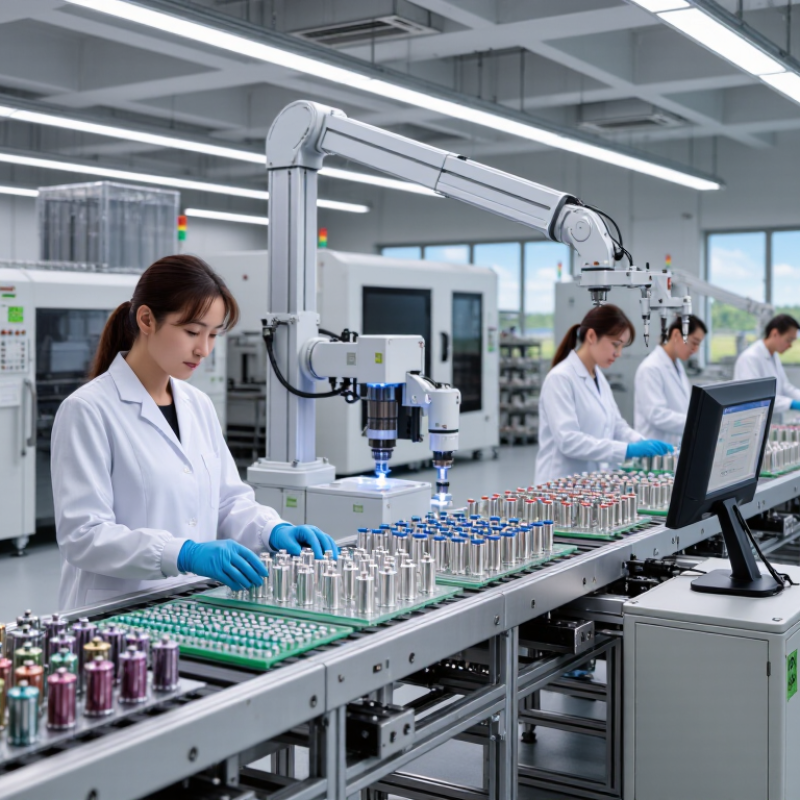
What Are Resonant Capacitors and Where Are They Used?
Resonant capacitors store and release electrical energy at a selected frequency. In an LC circuit, they work with inductors to create resonance. At that point, reactive energy moves between both components instead of being consumed immediately. The effect improves voltage transfer, filtering, and soft switching. The boundary is less tidy in real equipment.
Engineers use them in induction heating, wireless charging, high-frequency inverters, and resonant converters. In induction heating, a capacitor bank can face heavy current and rapid temperature changes. Wireless charging systems also depend on accurate capacitance matching between coils. The IEA’s Global EV Outlook 2024 recorded nearly 14 million electric car sales in 2023. That growth increases demand for efficient charging electronics, although not every charger uses the same resonant topology.
A suitable capacitor needs low equivalent series resistance, stable dielectric performance, and reliable pulse-current capability. Film types often serve high-power resonant circuits, while ceramic types fit compact, high-frequency assemblies. China’s leading suppliers should be compared through measured loss, endurance testing, traceable certificates, and production consistency. IEC 61071 addresses capacitors for power electronics, but laboratory compliance does not guarantee field reliability. Designers should still test vibration, humidity, thermal cycling, and abnormal switching conditions. Data from the U.S. Department of Energy’s power-electronics programs repeatedly highlights efficiency and thermal control as practical design priorities. Supplier claims deserve verification.
China Top 10 Resonant Capacitors Suppliers? - What Are Resonant Capacitors and Where Are They Used?
| No. | Resonant Capacitor Type | Common Dielectric or Construction | Typical Applications | Typical Frequency Range | Main Advantages | Important Selection Criteria |
|---|---|---|---|---|---|---|
| 1 | High-voltage ceramic resonant capacitor | Class 1 or Class 2 ceramic dielectric | Induction heating, high-voltage power supplies, resonant inverters | Approximately 20 kHz–1 MHz | High voltage capability, compact size, low cost | Rated voltage, dielectric loss, capacitance stability, cooling method |
| 2 | Polypropylene film resonant capacitor | Metallized or film-and-foil polypropylene | Solar inverters, electric-vehicle chargers, DC-link and AC resonant circuits | Approximately 1 kHz–200 kHz | Low dissipation factor, good self-healing, high pulse-current capability | RMS current, peak current, dv/dt rating, lifetime and thermal rise |
| 3 | Pulse film capacitor | Polypropylene film with reinforced winding or film-and-foil construction | Pulse discharge, resonant converters, laser power systems | Approximately 1 kHz–500 kHz | Handles high peak current and repetitive electrical pulses | Pulse energy, repetition rate, peak current, insulation and terminal design |
| 4 | High-current water-cooled capacitor | Film or ceramic element with integrated liquid cooling | Industrial induction heating and high-power frequency converters | Approximately 1 kHz–100 kHz | Supports high continuous RMS current and improved heat removal | Water flow, pressure, coolant quality, current rating and leakage protection |
| 5 | RF ceramic capacitor | Low-loss ceramic, often with silver or copper-based electrodes | RF heating, communications equipment, matching networks and antenna circuits | Approximately 1 MHz–1 GHz | Low parasitic inductance and stable high-frequency performance | Q factor, equivalent series inductance, voltage rating and temperature coefficient |
| 6 | Variable vacuum capacitor | Vacuum-insulated electrode structure | RF transmitters, plasma generators and adjustable matching networks | Approximately 100 kHz–100 MHz | Very low loss, high voltage withstand and adjustable capacitance | Capacitance range, maximum RF current, tuning mechanism and cooling |
| 7 | Power ceramic capacitor | High-voltage ceramic disc or multilayer ceramic construction | Microwave generators, medical equipment and high-frequency power systems | Approximately 100 kHz–300 MHz | High insulation resistance and strong voltage withstand capability | Capacitance tolerance, dielectric heating, corona resistance and mounting stress |
| 8 | Snubber and commutation capacitor | Low-inductance polypropylene film | IGBT, MOSFET and thyristor switching circuits | Approximately 1 kHz–1 MHz | Reduces voltage overshoot, ringing and switching stress | ESR, ESL, peak current, dv/dt rating and pulse durability |
| 9 | AC filter and resonant capacitor | Self-healing metallized polypropylene film | Grid-connected converters, UPS systems and harmonic filters | Approximately 50 Hz–20 kHz | Suitable for continuous AC operation and harmonic-current absorption | AC voltage, RMS current, harmonic spectrum, environmental class and lifetime |
| 10 | High-temperature resonant capacitor | Temperature-stable ceramic or high-temperature polypropylene film | Automotive power electronics, aerospace systems and industrial converters | Approximately 10 kHz–500 kHz | Maintains electrical performance over a wide operating-temperature range | Operating temperature, thermal derating, vibration resistance and qualification standards |
Note: Frequency ranges are general engineering reference values. Actual operating limits depend on capacitance, voltage, RMS current, equivalent series resistance, equivalent series inductance, cooling conditions and circuit topology.