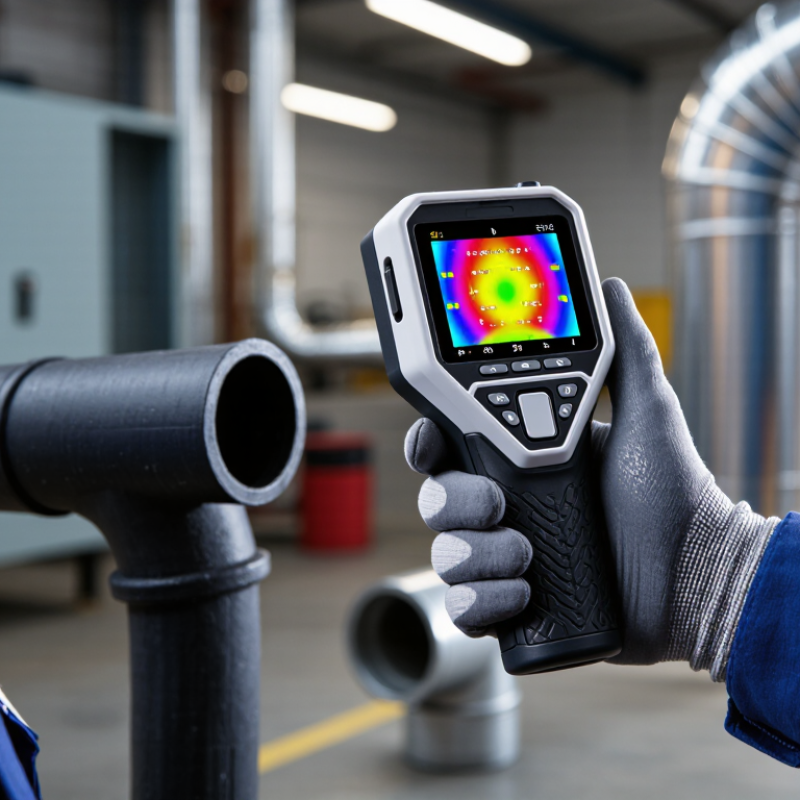
| Measurement Principle | Non-contact infrared radiation detection | The sensor detects thermal infrared energy emitted by a surface and converts it into a temperature reading without physical contact. | Suitable for moving, hot, distant, fragile, or electrically hazardous objects. |
| Spectral Band | Typically 8–14 µm for general surface temperature measurement | The long-wave infrared band is commonly used because many everyday materials emit thermal radiation effectively in this range. | Choose an 8–14 µm model for general inspection. Specialized bands may be needed for high-temperature or material-specific applications. |
| Temperature Range | Approximately −50°C to 550°C for general-purpose handheld units | The usable range defines the lowest and highest temperatures that can be measured within the stated accuracy. | Select a range that exceeds the expected target temperature by a practical safety margin. |
| Accuracy | Commonly ±1.5°C or ±1.5% of reading | Accuracy indicates how close the displayed value is to the actual surface temperature under specified conditions. | For routine maintenance, ±1.5°C or ±1.5% is often adequate. Use a calibrated, higher-accuracy instrument for critical measurements. |
| Repeatability | Often within ±0.5°C to ±1.0°C | Repeatability describes how consistently the sensor produces the same result when measuring the same target under unchanged conditions. | Prioritize strong repeatability when monitoring gradual temperature changes or comparing multiple components. |
| Response Time | Typically 0.5–1.0 second | Response time is the interval required for the displayed reading to approach the target temperature after aiming at a new surface. | Choose a faster response for moving machinery, production lines, electrical scanning, or rapidly changing processes. |
| Distance-to-Spot Ratio | Common values: 10:1, 12:1, 20:1, or higher | A 12:1 ratio means the sensor measures an area about 1 unit wide from 12 units away. The measured spot must fully cover the target. | Use 10:1 for close-range checks and at least 20:1 for small or difficult-to-reach targets. |
| Smallest Measurable Target | Usually 25–50 mm at a distance of 300–600 mm | The target should be larger than the sensor's measurement spot; otherwise, surrounding surfaces can influence the reading. | Select a narrow field of view when inspecting connectors, fuses, bearings, pipes, or small electronic components. |
| Emissivity Adjustment | Fixed setting or adjustable from approximately 0.10 to 1.00 | Emissivity describes how efficiently a surface emits infrared energy. Dull, non-metallic surfaces generally have high emissivity, while shiny metals often have low and variable emissivity. | Choose adjustable emissivity for mixed materials, painted metal, polished surfaces, or comparative inspections. |
| Emissivity Examples | Matte paint: about 0.90–0.95; oxidized metal: about 0.70–0.90; polished metal: often below 0.30 | Actual emissivity depends on surface finish, oxidation, viewing angle, wavelength, and temperature. | For shiny surfaces, use high-emissivity tape or a reference coating when practical, then measure after thermal equilibrium. |
| Optical Aiming | Laser pointer, crosshair, or illuminated target area | Aiming assistance helps position the sensor, but the laser location may not represent the full measurement spot on basic models. | Choose a defined crosshair or target-circle display when accurate positioning and documentation are important. |
| Display and Data Logging | Backlit display; memory commonly stores 20–500 readings | A clear display improves readability in dark or bright work areas, while memory functions support comparisons and inspection records. | Select backlighting and data logging for preventive maintenance, audits, and repeated measurements. |
| Alarm Function | High/low temperature alarms with user-defined limits | An alarm alerts the operator when a measured surface exceeds a configured threshold. | Useful for electrical panels, motors, bearings, HVAC systems, food checks, and process monitoring. |
| Environmental Protection | Common handheld protection levels: IP54 to IP65 | The IP rating describes resistance to dust and water ingress. It does not guarantee protection against immersion, chemicals, or impact. | Use at least IP54 for general field work and a higher rating for dusty, damp, or outdoor environments. |
| Operating Temperature | Typically 0°C to 50°C for the instrument body | This is the ambient temperature range in which the handheld unit is designed to operate, not the target measurement range. | Check the specification when working in freezers, furnaces, cold rooms, or hot industrial areas. |
| Battery Life | Commonly 8–20 hours of intermittent use | Battery life varies with display brightness, laser use, wireless functions, battery type, and measurement frequency. | Choose replaceable batteries for field service or rechargeable batteries for frequent daily inspections. |
| Calibration and Verification | Recommended verification at least annually or according to risk and usage | Calibration compares the instrument with a traceable reference. Verification checks whether performance remains within an accepted tolerance. | Use scheduled calibration for regulated, safety-critical, laboratory, or quality-control applications. |
| Best Application Fit | Electrical inspection, mechanical maintenance, HVAC, process checks, and building diagnostics | Handheld infrared sensors are best for rapid surface-temperature screening and locating abnormal thermal patterns. | For detailed temperature maps or hidden thermal patterns, consider a thermal imaging instrument instead of a single-point sensor. |