
01302 246818

China Top Rail Web Broadband Damper Manufacturer?

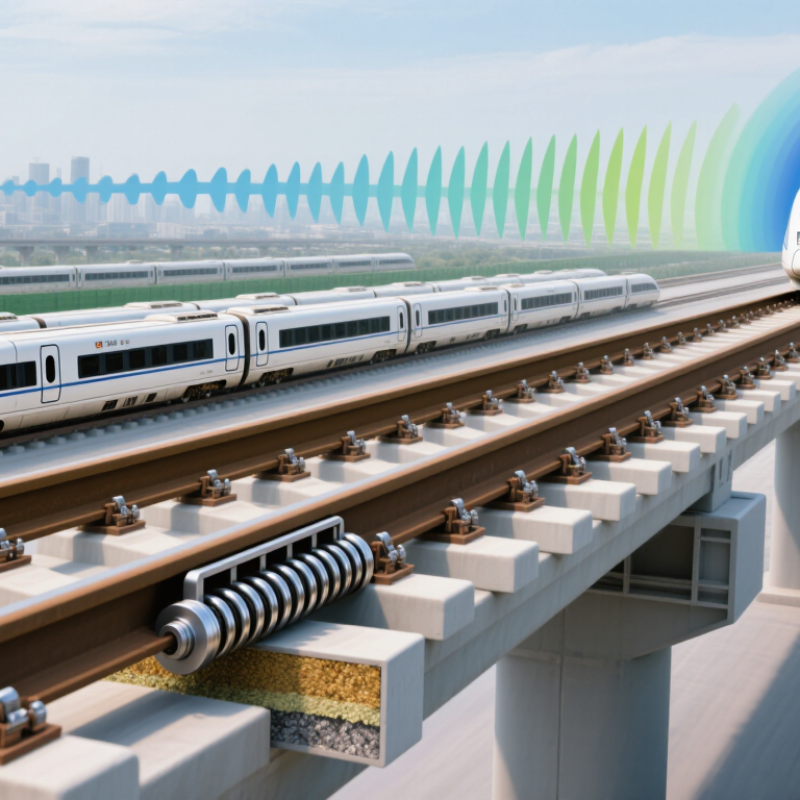
China’s rail network continues to expand, while noise control faces stricter performance expectations. The Rail Web Broadband Damper has become a practical option for reducing rail vibration and structure-borne noise. It works along the rail web, where resilient components absorb a broader frequency range than narrow-band solutions.

The European Environment Agency’s Environmental Noise in Europe 2020 report identified railway noise as affecting more than 20 million people across Europe. The World Health Organization also recommends limiting railway noise exposure to protect public health. These findings explain why railway operators increasingly examine damping performance, durability, installation quality, and lifecycle cost together.

China has a mature rail manufacturing base, supported by extensive high-speed, metro, and heavy-haul applications. However, “top manufacturer” should not depend on factory scale alone. It should reflect tested attenuation, material stability, fatigue resistance, and field experience. UNIFE’s World Rail Market Study 2024 also highlights continued global rail investment and growing attention to lifecycle value.

A reliable Rail Web Broadband Damper manufacturer should provide traceable test data, application guidance, and clear quality controls. Relevant evaluations may reference railway noise procedures under ISO 3095 and vibration requirements under project-specific standards. Results can vary with rail profile, fastening stiffness, axle load, temperature, and maintenance conditions.

No damper fits every line.

A promising product may still underperform after installation. That is an important limitation. This article examines China’s leading manufacturers through technical capability, verification methods, production consistency, customization, and after-sales support. The goal is not to repeat marketing claims, but to identify suppliers that can perform reliably beside real tracks.
China Top Rail Web Broadband Damper Manufacturer?

What Is a Rail Web Broadband Damper?

China Top Rail Web Broadband Damper Manufacturer?

What Is a Rail Web Broadband Damper?

A rail web broadband damper is a vibration-control device fixed to the vertical web of a railway rail. It combines added mass, resilient elements, and damping materials. Together, these parts reduce vibration across a wide frequency range. Unlike a narrow tuned absorber, it can address changing wheel, rail, and track conditions. This helps lower rolling noise and limits vibration transmitted into nearby structures.

During practical inspections, engineers examine bolt tightness, contact surfaces, corrosion protection, and clearance from maintenance equipment. A reliable damper should maintain stable performance through temperature changes, repeated wheel loads, and moisture exposure. Factory validation may include modal testing, fatigue testing, environmental checks, and noise measurements. Results should be traceable to documented procedures. Small installation errors can weaken performance. That point is sometimes underestimated.

Tips: Match the damper to the rail profile and target frequency range. Check clearance before installation. Reinspect fasteners after early service operation. Keep test records for future maintenance decisions. Field conditions rarely match laboratory assumptions perfectly, so monitoring remains valuable.

How Rail Web Broadband Dampers Work

China Top Rail Web Broadband Damper Manufacturer?

Rail web broadband dampers reduce vibration by converting mechanical energy into small amounts of heat. They are mounted along the rail web, usually between the rail head and foot. When a wheel passes, the rail bends and vibrates rapidly. The damper moves with the rail, but its internal mass or viscoelastic layer responds differently. This relative motion creates resistance. The vibration loses energy instead of travelling farther along the track.

The word broadband matters. A narrow-band device targets one frequency, while a broadband damper works across several changing frequencies. Wheel condition, rail profile, train speed, and track stiffness can all shift the vibration pattern. A practical damper therefore needs suitable mass, stiffness, and damping properties. Its clamps must maintain firm contact without damaging the rail. Small installation errors can reduce performance.

Field testing should include vibration measurements before and after installation. Inspectors may compare rail acceleration, noise levels, and fastener movement. Results are not always tidy. Temperature, moisture, and uneven track geometry can affect readings. This is where careful engineering matters. A damper that performs well in a laboratory may need adjustment on older track. It is better to verify performance than promise a perfect result. Regular inspections also reveal loose fittings, wear, or contamination before they become larger maintenance concerns.

China Top Rail Web Broadband Damper Manufacturer? – How Rail Web Broadband Dampers Work

Technical overview of rail-web broadband dampers, their operating principle, installation features, and typical performance considerations

Data Dimension Typical Information How It Works or Why It Matters Engineering Consideration
Product Function Rail vibration-control device installed on or around the rail web It reduces vibration generated by wheel–rail contact and limits the transmission of structure-borne noise into sleepers, fasteners, bridges, tunnels, and nearby buildings. Performance depends on rail profile, track construction, train speed, axle load, wheel condition, and the surrounding structure.
Primary Operating Principle Dynamic absorption combined with energy dissipation A mass–spring–damper system responds to rail vibration. The auxiliary mass moves relative to the rail and dissipates part of the vibration energy through damping materials or mechanical damping elements. The device should be tuned to the dominant vibration modes of the target rail section and operating condition.
Meaning of “Broadband” Effective attenuation across a frequency range rather than at one narrow frequency Broadband designs use damping, multiple resonant elements, distributed parameters, or a deliberately widened response range to control changing wheel–rail excitation frequencies. A broader working range can improve robustness, but peak attenuation at one exact frequency may be lower than that of a narrowly tuned absorber.
Main Components Inertial mass, elastic element, damping element, housing, and mounting hardware The inertial mass supplies the counteracting force, the elastic element controls relative motion, and the damping element converts vibration energy into heat. Materials and fasteners must withstand repeated loading, moisture, temperature changes, corrosion, and railway maintenance activities.
Installation Location Along the rail web, normally below the rail head and above the fastening zone Mounting close to the rail’s bending motion allows the device to interact directly with rail vibration while keeping the running surface unobstructed. Clearance from wheels, brake components, insulating joints, clips, drainage paths, and inspection equipment must be verified before installation.
Typical Target Frequency Range Commonly designed for selected rail vibration bands, often from approximately 100 Hz to 1,000 Hz Wheel–rail roughness, rail bending modes, fastening stiffness, and vehicle speed can produce excitation over a wide frequency range. This is an indicative engineering range, not a universal specification. Site measurements and modal analysis are required for final tuning.
Vibration Reduction Mechanism Reduction of rail acceleration and vibration amplitude When the damper moves out of phase with the rail, it absorbs vibrational energy and lowers the rail’s response near the designed operating band. Measured results are usually reported in decibels, acceleration levels, vibration velocity, or insertion loss under defined test conditions.
Noise-Control Effect Potential reduction of rolling noise and structure-borne noise Lower rail vibration reduces the radiated noise from the rail and can reduce vibration transferred through sleepers, fasteners, decks, and tunnel structures. It does not replace wheel maintenance, rail grinding, resilient fasteners, barriers, or other noise-control measures when those are required.
Rail Compatibility Must be matched to rail profile, rail mass, support stiffness, and fastening arrangement The dynamic response of a rail is affected by its cross-sectional geometry, mass per unit length, bending stiffness, and support conditions. Compatibility checks should include rail section, gauge clearance, electrical insulation, fastening access, and allowable additional mass.
Material Requirements Steel or other durable structural materials with elastomeric or metallic damping elements Structural parts carry cyclic loads, while damping components provide controlled relative movement and energy dissipation. Material selection should account for fatigue strength, corrosion protection, ultraviolet exposure, temperature range, oil contamination, and water ingress.
Environmental Conditions Outdoor railway environments with vibration, dust, moisture, temperature variation, and ballast impact risk The damper must maintain its mechanical properties during repeated train passages and changing weather conditions. Ingress protection, drainage, corrosion resistance, low-temperature performance, and resistance to ballast strikes should be assessed for the application.
Expected Service Life Project-specific; commonly designed for long-term railway service with periodic inspection Service life is governed by fatigue cycles, damping-element aging, fastener loosening, corrosion, contamination, and accidental mechanical damage. A precise service-life value should be supported by fatigue testing, environmental testing, maintenance records, and the actual traffic loading spectrum.
Inspection Items Fastener torque, cracks, corrosion, deformation, loose parts, clearance, and damping-element condition Visual and mechanical inspections confirm that the device remains securely attached and capable of controlled relative motion. Inspection intervals should follow the railway operator’s maintenance rules, risk assessment, traffic intensity, and supplier-approved procedures.
Performance Verification Before-and-after vibration or noise measurements under comparable operating conditions Testing can compare rail acceleration, vibration velocity, sound pressure level, or structural response before and after installation. Results should document train type, speed, wheel and rail condition, sensor positions, track construction, weather, and measurement bandwidth.
Key Benefits Passive operation, compact rail-side installation, reduced rail vibration, and potential noise mitigation Passive dampers do not require external power or active control systems and can operate continuously while trains pass. Actual benefits vary by site. A field survey is necessary to determine whether rail vibration is a dominant contributor to the measured noise or vibration problem.
Main Limitations Frequency dependence, installation constraints, added maintenance requirements, and site-specific results A damper cannot eliminate all vibration because wheel defects, rail roughness, vehicle suspension, ground transmission, and structural resonance may remain significant. Selection should be based on measured vibration data and a system-level assessment rather than product dimensions alone.
Recommended Selection Data Rail profile, train speed, axle load, traffic volume, vibration spectrum, support stiffness, and noise target These parameters define the excitation forces and dynamic response that the damper must control. Accurate input data improves tuning, installation planning, predicted attenuation, and lifecycle cost evaluation.

Note: Values and ranges shown above are general engineering references for rail-web broadband damper applications. Final dimensions, tuning frequencies, damping characteristics, installation spacing, and verified reduction levels must be determined through project-specific testing and railway approval procedures.

Key Performance Standards for Rail Web Broadband Dampers

China Top Rail Web Broadband Damper Manufacturer?

Key Performance Standards for Rail Web Broadband Dampers

A rail web broadband damper must control vibration across a wide frequency range, not just at one test point. Its dynamic stiffness should remain stable under repeated wheel loads, temperature changes, and track movement. Engineers should review frequency-response curves, loss factor, and vibration reduction results from laboratory and field tests. Small details matter.

Durability is equally important. The damper should resist fatigue, moisture, salt spray, dust, and ultraviolet exposure. Material performance must remain reliable in both winter cold and summer heat. Fire behavior, material traceability, and production consistency should meet the project’s railway standards and local compliance requirements. Each batch needs documented inspection records. Fit is critical.

A dependable manufacturer also verifies installation conditions. Rail web thickness, fastening torque, surface cleanliness, and clearance can directly affect damping performance. Practical validation should include running measurements, visual inspections, and checks after heavy service cycles. A high laboratory score is not enough. Field conditions are less predictable, and this is where some designs need honest reconsideration. Clear test methods, calibrated equipment, and independent technical review make performance claims more credible. The best selection balances damping efficiency, service life, maintainability, and consistent quality rather than relying on one impressive number.

Why China Is a Major Manufacturing Base

China Top Rail Web Broadband Damper Manufacturer?

China has become a major manufacturing base for rail web broadband dampers because demand, engineering talent, and supply chains are concentrated together. China Railway Statistical Bulletin reported approximately 159,000 kilometers of operating railway lines by the end of 2023, including about 45,000 kilometers of high-speed routes. This extensive network creates continuous demand for vibration-control components near wheels, rails, bridges, and tunnels.

Scale matters.

The 2023 railway investment figure exceeded 760 billion yuan, according to official railway industry statistics. Such spending supports testing laboratories, precision machining, elastomer production, and railway certification services. In practical factory audits, a capable damper supplier should control rubber hardness, bonding strength, steel tolerance, and fatigue performance. Small deviations can change resonance behavior. That point is often underestimated.

China’s manufacturing advantage also comes from dense regional suppliers. Steel processing, mold production, surface treatment, and electronic testing can often be coordinated within short transport distances. The China Statistical Yearbook 2024 shows the country’s broad industrial capacity and large manufacturing workforce, supporting faster tooling adjustments and stable component sourcing. However, low price alone proves little. Suppliers still need traceable materials, repeatable dynamic testing, and documented performance under temperature changes. Some specifications remain difficult to compare across projects. That is where buyers must ask better questions.

How to Evaluate a Top Chinese Manufacturer

China Top Rail Web Broadband Damper Manufacturer?

How to Evaluate a Top Chinese Manufacturer

Selecting a Chinese rail web broadband damper manufacturer requires evidence, not attractive catalog images. UNIFE’s World Rail Market Study 2024 estimates the global rail supply market at about €200 billion annually, with continued growth through 2027. This scale increases supplier choices, but also makes technical screening essential. Request material certificates, fatigue-test results, damping curves, and dimensional inspection records for each production batch. A reliable factory should explain its test method clearly.

Check whether the manufacturer operates under ISO 9001 and ISO 22163 quality systems. For rail components, EN 15085 welding controls may also matter when welded structures are included. Ask for test conditions that match your application: axle load, vibration frequency, temperature range, corrosion exposure, and service life. The International Union of Railways publishes technical guidance and statistical data showing the importance of consistent railway asset performance. Yet a certificate alone proves little.

Visit the production line if possible. Look for calibrated force sensors, traceable rubber or metal materials, controlled assembly areas, and sample retention. Compare three consecutive batches, not one perfect sample. A small detail matters: the damper should fit without forced alignment or uneven bolt pressure. I would also check response time for corrective actions. My own checklist can miss supplier subcontracting, especially during peak orders. Therefore, confirm who performs machining, coating, testing, and final release before signing technical documents.