
What Is the Best PE Tarpaulin Manufacturer in China?
Choosing the best Pe Tarpaulin manufacturer in China requires more than comparing factory prices. Product performance depends on resin quality, weaving density, lamination, stitching, and testing discipline. A blue cover may look identical in a catalog. It may fail differently under sunlight, wind, or repeated folding.
Industry data shows why supplier selection matters. PlasticsEurope’s Plastics—The Fast Facts 2024 reports approximately 413.8 million tonnes of global plastics production in 2023. China represented about one-third of that output. This scale supports strong material access and manufacturing capacity. However, scale alone does not guarantee reliable tarpaulin performance. Buyers should request measurable specifications, including fabric weight, tensile strength, tear resistance, seam strength, coating thickness, and ultraviolet resistance.
Details matter.
A credible manufacturer should explain its production process clearly. Look for documented batch control, calibrated testing equipment, and traceable raw materials. Relevant evaluations may reference ASTM D751, ISO 4892-3, or equivalent customer specifications. Independent inspection reports can strengthen confidence, especially for large orders. Certifications such as ISO 9001 are useful, but they do not replace product testing.
The best Pe Tarpaulin manufacturer is therefore the one matching the application, not merely offering the lowest quotation. Construction covers, agricultural sheets, truck tarps, and emergency shelters require different balances of weight, flexibility, waterproofing, and service life. Some suppliers communicate impressively but provide limited evidence. That is worth questioning. A practical comparison should include samples, test results, production photographs, packaging details, and after-sales response. Price still matters. It should not be the only answer.
What Is a PE Tarpaulin and Where Is It Used?
What Is the Best PE Tarpaulin Manufacturer in China?
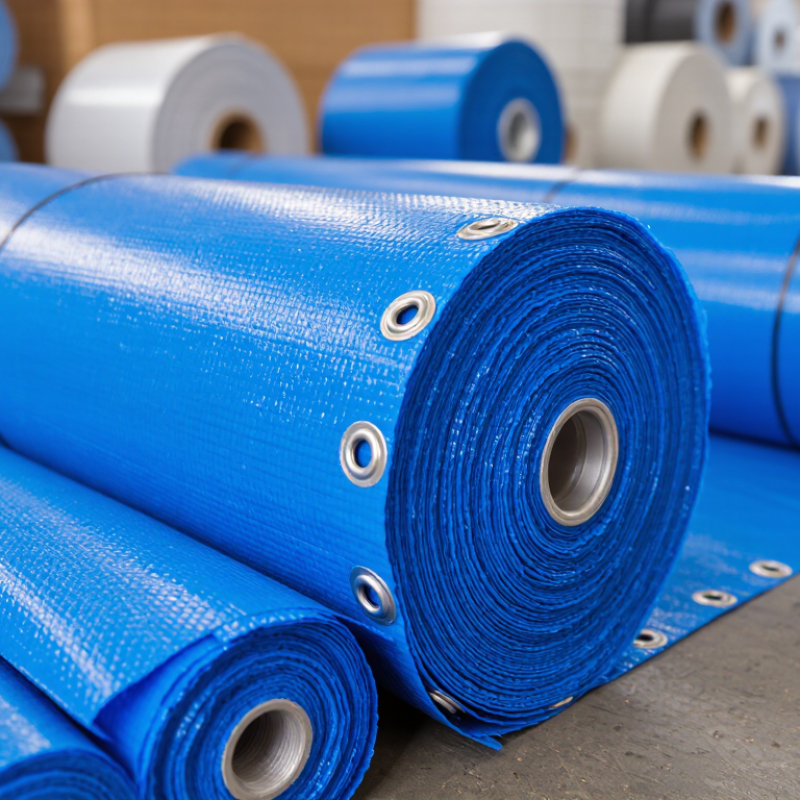
A PE tarpaulin is a woven polyethylene fabric covered with protective plastic film. This structure creates a lightweight, waterproof, and flexible sheet. Many products include reinforced edges, rust-resistant eyelets, and heat-sealed seams. These details affect service life more than appearance alone.
PE tarpaulins protect hay, machinery, building materials, and outdoor furniture from rain and dust. Farmers use them over feed, soil, and temporary storage areas. Construction crews cover sand, timber, and equipment during changing weather. Logistics teams place them over open truck loads. They also work as ground sheets, shade covers, and temporary partitions. It is practical. Not always perfect.
A dependable Chinese manufacturer should explain fabric weight, coating thickness, tensile strength, and tear resistance clearly. UV resistance matters when a sheet stays under strong sunlight for months. Eyelet spacing and corner reinforcement deserve close inspection. A sample test can reveal weak seams, uneven coating, or brittle material. I have found that a low price can look attractive during purchasing, yet fail after one rainy season. This judgment needs evidence, not assumptions. Buyers should request production samples, quality records, and independent inspection when the order is important. Even excellent PE tarpaulin has limits. Sharp edges, constant rubbing, and poor drainage can damage it faster than expected.
What Is the Best PE Tarpaulin Manufacturer in China? - What Is a PE Tarpaulin and Where Is It Used?
Key product specifications, practical applications, and quality indicators for evaluating PE tarpaulin suppliers
| Evaluation Dimension | Common Commercial Specification | Material or Construction Detail | Typical Applications | What to Check When Selecting a Manufacturer |
|---|---|---|---|---|
| Basic Material | Polyethylene woven fabric with polyethylene coating | Woven HDPE or LDPE tapes form the scrim; laminated polyethylene layers provide water resistance and surface protection. | General covers, temporary shelters, construction protection, agricultural covering | Confirm the polyethylene grade, coating uniformity, recycled-content disclosure, and consistency between production batches. |
| Fabric Weight | Approximately 60–250 g/m² for common products | Lower weights are easier to handle; higher weights generally provide greater strength and durability. | 60–100 g/m²: light-duty covers; 100–180 g/m²: general-purpose covers; 180–250 g/m²: heavy-duty protection | Request measured basis weight rather than relying only on nominal product names such as “light,” “medium,” or “heavy.” |
| Common Color Options | Blue, green, silver, white, black, and custom colors | Color is produced through pigments in the polyethylene coating; darker colors usually absorb more solar heat. | Blue and green for general covers; silver or white for reflective and heat-reducing applications; black for light blocking | Check color consistency, pigment dispersion, surface fading, and whether both sides meet the specified color requirement. |
| Water Resistance | Water-resistant or waterproof, depending on construction and seam design | Continuous polyethylene coating helps prevent liquid water penetration; stitched seams and eyelet areas are potential leakage points. | Rain covers, truck and trailer covers, outdoor storage, building-material protection | Ask for hydrostatic-pressure or water-penetration test results and inspect seam sealing, hems, and corner reinforcement. |
| Tensile Strength | Varies significantly with fabric weight, tape density, and coating structure | Strength is normally specified separately in the warp and weft directions because woven tape construction is directional. | Transportation covers, cargo protection, construction enclosures, industrial partitions | Require tested warp and weft values, test direction, sample conditioning, and the test method used, such as ISO 1421 or ASTM D5034 where applicable. |
| Tear Resistance | Higher tear resistance is preferred for repeated handling and windy conditions | Woven tape strength, coating adhesion, hem construction, and reinforcement patches all influence tear performance. | Truck covers, scaffolding covers, emergency shelters, frequently installed tarpaulins | Compare trapezoid or tongue-tear results and review performance around eyelets, hems, welded seams, and corners. |
| UV Resistance | Standard, enhanced, or long-term outdoor grades | UV stabilizers can slow fading and embrittlement, but service life also depends on sunlight intensity, temperature, wind, and handling. | Long-term outdoor storage, agricultural use, construction sites, recreational shelters | Request the UV-stabilizer specification and accelerated-weathering results; avoid accepting an unsupported fixed outdoor lifespan. |
| Temperature Performance | Use limits depend on formulation and exposure conditions | Polyethylene remains flexible at ordinary outdoor temperatures but can soften under high heat and become less flexible in severe cold. | Seasonal outdoor covers, warehouse protection, transport and storage applications | Confirm the recommended operating range and assess whether the product will contact hot surfaces, chemicals, or freezing materials. |
| Edge and Corner Reinforcement | Folded or hemmed edges with reinforced corners | Reinforcement distributes pulling forces and reduces damage caused by ropes, straps, and wind loading. | Large covers, vehicle tarpaulins, machinery covers, temporary structures | Inspect hem width, reinforcement patches, stitching density, weld quality, and the attachment strength of corner components. |
| Eyelets or Grommets | Common spacing ranges from approximately 50 cm to 100 cm | Eyelets may be made from metal or other specified materials and are installed through reinforced hems or patches. | Rope-down covers, temporary buildings, truck covers, fencing and privacy screens | Confirm eyelet material, inside diameter, spacing tolerance, corrosion resistance, and pull-out strength. |
| Available Dimensions | Standard sheet sizes plus made-to-order widths and lengths | Large sheets may be produced by continuous weaving and lamination, with panels joined by heat welding or sewing. | Small equipment covers, pallet covers, truck-sized sheets, warehouse and event shelters | Check finished dimensions, dimensional tolerance, squareness, panel alignment, and whether the quoted size is cut size or finished size. |
| Seam Construction | Sewn, heat-welded, or reinforced combination seams | Heat welding can create a continuous plastic bond; sewing may require additional sealing for improved water resistance. | Large industrial covers, truck tarpaulins, tents, temporary buildings | Evaluate seam strength, water tightness, straightness, adhesive or weld consistency, and the quality of seam finishing. |
| Flame Performance | Standard PE tarpaulin is not automatically flame-retardant | Special flame-retardant formulations may be available, but performance must be verified against a named standard. | Events, construction enclosures, industrial settings, and applications with specific fire-safety requirements | Request the exact flame test standard, classification, certificate scope, and confirmation that it applies to the supplied fabric. |
| Quality Documentation | Technical data sheet, inspection report, and batch traceability | Reliable documentation should identify product construction, tolerances, test conditions, and inspection results. | Commercial procurement, export orders, infrastructure projects, and repeat supply programs | Choose a supplier able to provide pre-production samples, third-party testing when needed, lot records, and a clear quality-claim process. |
Note: The specifications above represent common commercial ranges and selection criteria, not a guarantee for every PE tarpaulin product. Actual performance depends on fabric construction, coating formula, dimensions, environmental exposure, installation, and testing conditions. Always approve a production sample and verify the relevant test reports before placing a large order.