01302 246818

What Are the 2026 Top Iron Strainer Types for Global Buyers?

Global buyers entering the 2026 kitchenware and light-industrial market need more than a simple product list. The right Iron Strainer depends on fluid temperature, particle size, corrosion exposure, cleaning methods, and required service life. Common options include cast-iron strainers, stainless-steel iron strainers, perforated basket models, wire-mesh designs, and heavy-duty Y-type or basket strainers. Each type creates a different balance between strength, filtration precision, weight, and maintenance.

Industry data supports this practical direction. The World Stainless Association’s recent market updates show continued global demand for stainless steel, especially where hygiene, durability, and corrosion resistance matter. Grand View Research also identifies food processing, water treatment, and industrial applications as major drivers of filtration-equipment demand. Meanwhile, UN Comtrade trade data can help buyers compare metalware flows, although it does not always separate Iron Strainer products from broader household or industrial categories. That limitation matters.

Not every published forecast is equally reliable.

This 2026 guide therefore compares strainer types through measurable buying criteria, including material grade, mesh opening, load capacity, connection size, surface finish, and replacement cost. Real purchasing conditions can be less tidy than catalog claims. A low-cost cast-iron body may withstand impact, yet its coating can require closer inspection. A fine mesh may improve particle control, but it can also clog faster. Buyers should verify test reports, supplier experience, batch consistency, and applicable standards before making a global order. The strongest choice is not always the most advanced one. It is the model that performs consistently in the buyer’s actual operating environment.

What Are the 2026 Top Iron Strainer Types for Global Buyers?

Iron Strainer Basics and the Key Features Buyers Should Compare

What Are the 2026 Top Iron Strainer Types for Global Buyers?

Iron strainers remove scale, rust flakes, and welding debris before pumps or valves suffer damage. The main types are Y-strainers, basket strainers, duplex strainers, and temporary cone strainers. Y-strainers suit compact pipelines and moderate debris loads. Basket designs provide greater collection capacity. Duplex models support continuous service during cleaning, but their switching system adds cost and maintenance points.

Buyers should compare filtration rating, free-flow area, pressure class, temperature range, and connection size. Mesh size alone can mislead. A fine screen may protect equipment better, yet it can create rapid pressure loss. A practical check is the differential-pressure reading before and after installation. According to the 2024 MarketsandMarkets Industrial Filtration Market report, the global industrial filtration market was valued at about USD 39 billion in 2024 and is forecast to grow steadily through 2029. This growth increases demand for measurable, serviceable filtration equipment.

Material details deserve equal attention. Cast iron is economical for many water systems, while ductile iron offers improved mechanical strength. Buyers should verify coating quality, gasket compatibility, drain design, and screen replacement access. Pressure testing should align with recognized requirements, such as ISO 5208 leakage-testing principles where applicable. Field failures often begin with poor sizing, not weak metal. That point is easy to overlook. I would also question any supplier offering mesh data without pressure-drop curves, inspection records, or traceable material certificates. Specification sheets are not enough.

What Are the 2026 Top Iron Strainer Types for Global Buyers?

Iron Strainer Basics and the Key Features Buyers Should Compare

The chart compares common iron strainer types by typical suitability for continuous service, maintenance convenience, filtration fineness, and flow capacity. Scores range from 1 to 5 and represent general design characteristics rather than market share or performance guarantees. Actual results depend on pipe size, mesh opening, pressure, temperature, fluid viscosity, and installation conditions.

Main Iron Strainer Types for Different Industrial and Household Uses

For global buyers in 2026, iron strainers should match the working fluid, pressure, and cleaning routine. Y-type strainers suit steam, water, and compressed-air lines with limited space. Basket strainers handle heavier debris and higher flow volumes. Duplex basket models support continuous operation because one chamber can be cleaned while the other remains active. A small mistake here can increase pressure loss.

Cast iron remains practical for general water systems and moderate industrial service. Ductile iron offers better impact resistance, making it useful for municipal pipelines, irrigation, and larger pumping stations. Temporary cone strainers protect pumps during commissioning, but they are not designed for permanent service. The 2024 MarketsandMarkets Industrial Valves report projects a 4.7% compound annual growth rate through 2028. That broader trend suggests stronger demand for reliable flow-control components, although it does not measure strainers alone.

Household and light-commercial uses need smaller threaded or compact Y strainers. They can protect water heaters, washing equipment, and pressure-reducing valves from rust flakes and pipe scale. Fine screens are not always better. They clog faster. The United Nations World Water Development Report 2024 states that agriculture accounts for about 70% of global freshwater withdrawals, supporting demand for durable irrigation filtration. Buyers should verify mesh size, pressure rating, coating, and gasket compatibility. A strainer is not a disinfection device. That distinction is easy to miss. Experiences from installation sites also show that access space matters as much as material selection.

Material, Coating, Size, and Filtration Standards by Buyer Requirements

What Are the 2026 Top Iron Strainer Types for Global Buyers?

Global buyers commonly compare Y-type, basket, duplex, and temporary iron strainers. Each design suits different flow conditions, maintenance plans, and installation spaces. Y-type strainers fit compact pipelines and moderate debris loads. Basket strainers provide larger collection areas for pumps, cooling systems, and process lines. Duplex models support continuous operation because one chamber can remain active during cleaning.

Material selection depends on fluid chemistry, pressure, and temperature. Ductile iron offers strong mechanical performance at a practical cost. Cast iron suits stable, low-impact water applications. Stainless steel screens resist corrosion and preserve accurate openings. For aggressive environments, buyers should verify compatibility instead of trusting general material labels. That detail is often missed.

Coating quality matters in humid plants and buried installations. Fusion-bonded epoxy or approved liquid epoxy can improve surface protection. The coating thickness should appear in inspection records. Common sizes range from DN25 to DN300, although larger pipelines require project-specific engineering. Screen openings may range from coarse millimeter slots to fine mesh levels. Buyers should specify filtration performance by micron rating, open area, and allowable pressure loss. A smaller opening is not always better. It can reduce flow sharply and increase cleaning frequency. Check the drawing twice. Flange dimensions, pressure classes, and testing requirements should match the destination market. Relevant references may include EN or ASME flange standards, material certificates, hydrostatic testing, and documented inspection procedures. Requirements vary by industry, and one universal specification can create expensive mistakes.

How to Evaluate Suppliers, Quality Control, and Global Compliance

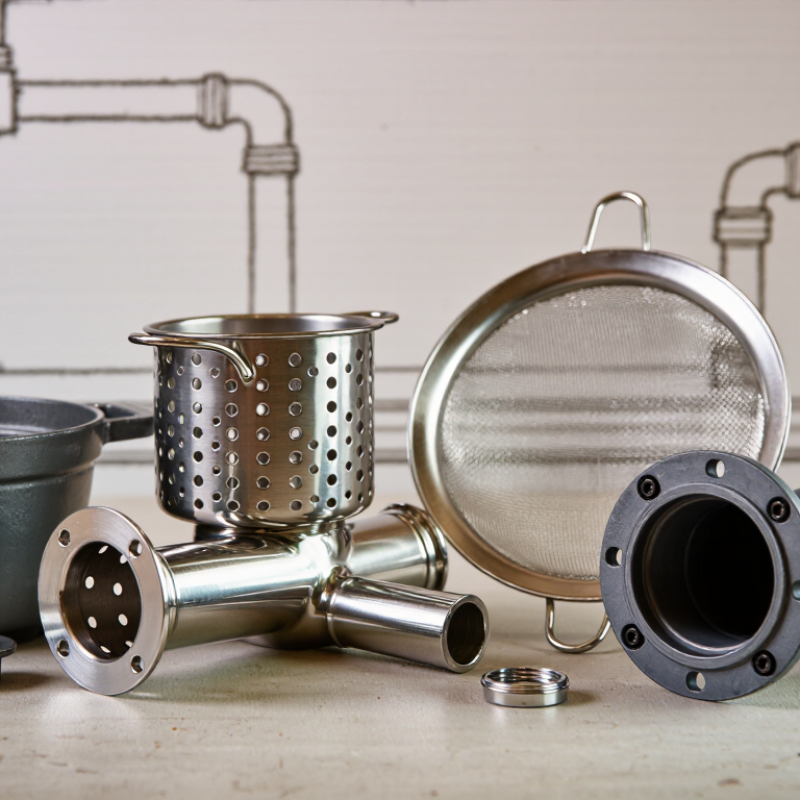
For 2026 global buyers, leading iron strainer choices include perforated baskets, fine-mesh strainers, conical chinois, and heavy-duty cast-iron sink models. Each suits a different task. Fine mesh captures smaller particles, while perforated baskets drain faster. Clarify the material carefully. “Iron” may mean carbon steel, cast iron, or stainless steel. These materials differ in corrosion resistance, weight, and food-contact suitability.

Supplier evaluation should begin with traceable material certificates, dimensional drawings, and production samples. The ISO Survey 2022 recorded 1,265,216 ISO 9001 certificates worldwide, but certification alone does not prove consistent strainer quality. Request batch records, hardness results, mesh-opening measurements, coating details, and salt-spray or corrosion-test reports. Check welds around handles. Inspect sharp edges by hand. A useful audit also compares the approved sample with random cartons. Small differences often appear there. I once underestimated packaging quality; bent rims created more complaints than defective mesh.

Tips: Ask for three consecutive batch samples. Measure openings at multiple points. Confirm food-contact declarations for the destination market. For European sales, review applicable REACH requirements and food-contact rules. For the United States, verify relevant FDA food-contact provisions. Use an independent laboratory when supplier data seems incomplete. The World Steel Association reported global crude steel production of about 1.88 billion tonnes in 2023, showing the scale of steel supply, not automatic reliability. Country-of-origin marking, tariff classification, testing language, and corrective-action procedures should be written into the purchase contract. Supplier promises can sound precise. Evidence is usually less polished.

What Are the 2026 Top Iron Strainer Types for Global Buyers? - How to Evaluate Suppliers, Quality Control, and Global Compliance

Strainer type Typical construction and filtration range Best-fit applications Key advantages Main limitations Quality-control checkpoints Supplier-evaluation evidence Relevant global compliance considerations
Basket strainer Cast, forged, or fabricated iron and steel body with a removable perforated plate or wire-mesh basket. Common openings range from approximately 0.5 mm to 6 mm, depending on the service. Liquid pipelines, cooling water, process water, pumps, heat exchangers, and general industrial services. Easy basket removal, low maintenance, reusable filter element, and good suitability for coarse-to-medium solids removal. Requires isolation or a duplex arrangement for continuous service. Pressure drop rises as the basket loads with debris. Body-wall thickness, basket fit, weld quality, gasket seating, drain arrangement, dimensional inspection, hydrostatic pressure test, and differential-pressure verification. Material certificates, pressure-test records, inspection and test plan, replacement-basket traceability, documented cleaning procedure, and calibration records for gauges. Pressure Equipment Directive 2014/68/EU may apply in the European Economic Area according to pressure, volume, fluid group, and equipment category. Confirm local piping and pressure-vessel rules.
Y-strainer Inline body with an angled chamber containing a perforated or woven-mesh screen. Typical screen openings are approximately 0.25 mm to 3 mm for many industrial services. Steam, water, compressed air, fuel, hydraulic circuits, and compact piping installations. Compact design, broad connection options, relatively low purchase cost, and simple installation in horizontal or suitable vertical lines. Small chamber volume can cause faster blockage. Cleaning usually requires line isolation unless an automatic blowdown arrangement is provided. Flow-direction marking, screen retention, thread or flange accuracy, casting inspection, body pressure test, screen open-area check, and gasket compatibility. Published pressure-temperature ratings, sample dimensional report, material grade confirmation, screen mesh or aperture report, and evidence of final visual inspection. For European shipments, assess PED applicability and harmonized or designated standards used in the technical file. For electrical or automation accessories, assess separate EMC and low-voltage requirements where applicable.
Duplex basket strainer Two basket chambers connected through a changeover valve or diverter arrangement. Baskets commonly use perforated plate, woven mesh, or multilayer screens. Continuous-flow systems, lubrication circuits, fuel handling, cooling loops, and processes where shutdown for cleaning is unacceptable. One side can remain in service while the other basket is cleaned, reducing process interruption and improving maintainability. Higher cost, greater weight, more seals, and a risk of incorrect valve positioning if the changeover mechanism is poorly designed. Interlock function, chamber isolation, valve seat leakage, changeover sequence, pressure test of each flow path, basket interchangeability, and safe vent and drain operation. Functional test video or report, assembly drawings, spare-parts list, failure-mode review, operating instructions, and documented pressure-drop data at stated flow rates. Pressure equipment documentation, machinery-safety assessment for actuated systems, transport packing validation, and destination-country language requirements should be reviewed before shipment.
Temporary cone or startup strainer Conical perforated plate or wire mesh installed between flanges. It is normally supplied for temporary commissioning and equipment-protection service rather than permanent filtration. New pipelines, pump suction protection, flushing operations, commissioning, and removal of weld slag or construction debris. Low cost, quick installation, large debris-holding capacity, and simple removal after system cleaning. Not generally intended for long-term service. Incorrect orientation or excessive loading can create high pressure loss and mechanical damage. Cone angle, support-ring flatness, weld integrity, flange alignment, screen opening, flow-direction marking, and resistance to collapse at the specified differential pressure. Drawing with installation orientation, material certificate, calculated open area, specified temporary-service duration, and clear removal instructions. Confirm that the item is classified correctly for the destination market and that the connected piping system meets applicable pressure and installation requirements.
Perforated-plate strainer Carbon steel, ductile iron, or stainless-steel housing fitted with a punched or drilled plate. Apertures are commonly specified by diameter, pitch, and open-area percentage. Water treatment, cooling water, intake lines, irrigation, and services containing relatively coarse solids. High mechanical strength, good resistance to coarse debris, straightforward cleaning, and stable aperture geometry. Usually provides less fine filtration than woven mesh. Punched edges and coatings must be controlled to avoid burrs and corrosion sites. Aperture diameter and pitch, burr height, plate thickness, coating adhesion, corrosion protection, weld inspection, and pressure-loss testing. Aperture inspection report, coating or lining procedure, salt-spray or corrosion-test evidence where specified, and batch traceability from plate to finished assembly. If supplied for drinking-water contact, verify the applicable national or regional positive-list and material-approval requirements; industrial-use compliance is not automatically sufficient.
Wedge-wire or slot strainer Profile-wire screen welded to support rods, or a machined slotted element. Slot sizes can be specified in fine increments, often from roughly 0.05 mm upward depending on design. Water wells, intake systems, food and chemical processing, wastewater, and applications requiring accurate particle separation. Accurate slot control, strong open structure, good cleanability, and reduced tendency for particles to become deeply embedded compared with some woven screens. Higher fabrication cost and the need for precise welding, support spacing, and particle-loading calculations. Slot-size uniformity, weld penetration, support spacing, screen roundness, fatigue resistance, open-area calculation, and cleanability testing. Microscope or calibrated optical inspection, weld-quality records, design calculations, pressure or collapse test, and documented tolerances for slot size and roundness. Food, beverage, pharmaceutical, and drinking-water applications require product-contact materials and hygienic-design documentation appropriate to the destination jurisdiction.
Magnetic separator strainer A liquid strainer combined with permanent magnetic bars or cores to capture ferrous particles. The nonmagnetic screen retains larger solids while the magnetic element captures metal fines. Food ingredients, ceramics, plastics, paints, chemicals, oils, and process liquids where ferrous contamination is a concern. Provides two separation mechanisms and can reduce metal contamination without adding a separate process stage. Magnetic performance may decline with contamination, temperature, impact, or unsuitable design. It does not remove non-ferrous metals reliably. Magnetic flux measurement at defined points, encapsulation integrity, corrosion resistance, screen fit, cleanability, maximum operating temperature, and pressure testing. Flux-density map, temperature rating, magnet-grade and coating documentation, extraction-force test, food-contact declaration where relevant, and cleaning validation. For food-contact use, review applicable food-contact framework, migration data, hygienic design, and allergen-cleaning controls. Check whether the destination requires metal-detection or foreign-body control documentation.
Self-cleaning or automatic backwash strainer Robust body with screen, scraper, suction scanner, or backwash mechanism. Filtration openings commonly range from tens of micrometres to several millimetres, depending on process needs. Large cooling-water systems, irrigation, desalination pretreatment, industrial water reuse, and continuous-flow utilities. Reduces manual cleaning, supports continuous operation, and can maintain more stable pressure drop when correctly sized and controlled. Higher capital cost, control-system dependence, backwash-water demand, and greater sensitivity to incorrect sizing or poor water-quality assumptions. Screen strength, backwash sequence, actuator reliability, sensor calibration, drain capacity, fail-safe behavior, pressure-drop set points, and cycle endurance. Control logic, wiring diagram, factory acceptance test, simulated blockage test, spare-parts strategy, maintenance schedule, and documented performance curve. Electrical controls may require assessment under destination-market electrical, EMC, machinery, or functional-safety rules. Provide manuals, labels, and safety information in required languages.
Buyer verification checklist: Confirm the fluid, temperature, pressure, flow rate, particle size, required filtration accuracy, allowable pressure drop, connection standard, body and screen materials, gasket material, cleaning method, and expected service life before comparing quotations. Request material certificates to EN 10204 Type 3.1 when specified, use a documented inspection plan, and verify sampling against ISO 2859-1 or an agreed equivalent. For woven screens or sieve-style openings, clarify whether the supplier references ISO 3310-1, ASTM E11, or another applicable aperture standard. Compliance claims should be supported by test reports, declarations, technical files, and destination-specific requirements rather than by certificates alone.

2026 Selection Trends, Cost Factors, and Purchasing Considerations

For global buyers in 2026, iron strainers are moving toward practical, serviceable designs. Y-type strainers suit compact pipelines and frequent flushing. Basket strainers offer larger debris capacity. Duplex basket units reduce shutdowns because one chamber can operate while the other is cleaned. Temporary cone strainers remain useful during commissioning, but they are not a permanent solution.

Material choice now affects the purchase price more sharply. World Steel Association’s World Steel in Figures 2025 reported about 1.88 billion tonnes of crude steel production in 2024. That huge supply base does not guarantee stable strainer prices. The World Bank Commodity Markets Outlook identifies energy, metals, and freight costs as important industrial cost pressures. Buyers should compare ductile iron, cast iron, and carbon steel by pressure rating, temperature, corrosion exposure, and wall thickness. A cheaper body may require earlier replacement.

Mesh accuracy matters. A 1-millimetre opening can protect pumps, while a finer screen may restrict flow. Ask for pressure-drop data at the expected flow rate. Request material certificates, hydrostatic test records, coating details, and dimensional drawings. ISO 9001 certification supports process control, but it does not prove every unit is suitable. Check the actual test scope. Freight also deserves attention; heavy iron bodies can make landed cost exceed the factory quotation. Some buying teams still compare unit prices only. That habit needs reconsideration.