
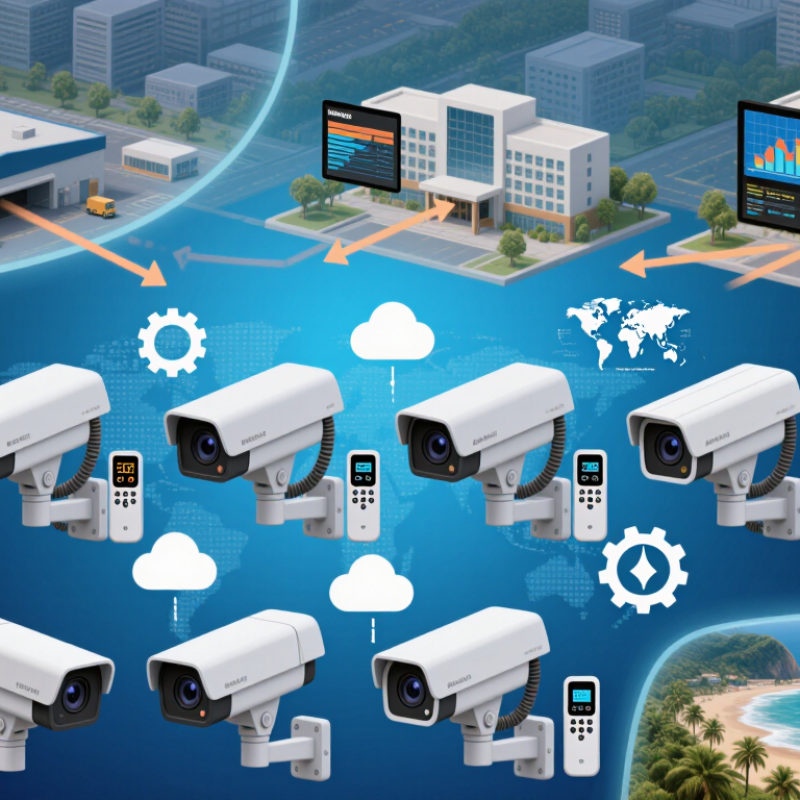
Global buyers are rethinking how one camera can monitor wide, complex spaces. A Pan Tilt Video Platform combines pan, tilt, zoom, remote control, analytics, and cloud or on-premise management. It can follow movement across a warehouse yard, inspect a hotel entrance, or survey a coastline from one control screen.
The opportunity is expanding. Grand View Research valued the global video surveillance market at approximately USD 53.7 billion in 2023 and projected strong growth through 2030. MarketsandMarkets also identifies cloud video surveillance, artificial intelligence, and remote monitoring as major growth drivers. These figures describe the broader market, not every Pan Tilt Video Platform. Still, they show why buyers are comparing platforms more carefully.
John Honovich, founder of IPVM, has often emphasized the practical role of PTZ systems: “PTZ cameras are not a replacement for fixed cameras; they are complementary.” That distinction matters. A moving lens can create a blind spot while tracking an object. It also depends on network reliability, operator training, cybersecurity, and accurate presets.
This guide evaluates ten platforms for international buyers. It considers optical zoom, tracking accuracy, latency, integration support, data protection, maintenance, and total ownership cost. Regional availability matters too. A low purchase price may hide licensing fees, replacement delays, or limited technical support.
Not every platform fits every site. That is the difficult part. The best choice depends on coverage geometry, lighting, staffing, and local requirements. Our comparisons aim to make those trade-offs visible, using manufacturer documentation, independent market research, and real-world deployment considerations.
Global PTZ demand is expanding with wider surveillance budgets. IDC’s 2023 Worldwide Security Spending Guide estimated global security spending at about $219 billion. That figure includes cybersecurity, services, and physical protection. PTZ platforms compete within this broader investment.
MarketsandMarkets valued the video surveillance market at roughly $53.7 billion in 2023. Its report forecasts continued growth through 2028, supported by analytics, cloud management, and urban monitoring. Buyers now expect smooth zoom control, low-light clarity, and reliable remote access. A platform may look impressive in a showroom. Field performance can differ. Rain, weak networks, and dusty lenses expose weaknesses quickly. The ten strongest options should therefore be judged by uptime, integration, cybersecurity controls, and total ownership cost. Specifications alone are not enough.
Tips:
Test a PTZ platform at night. Use a 200-meter corridor, moving subjects, and unstable bandwidth. Check whether tracking remains stable. Verify storage costs, update policies, and operator permissions before purchase. Omdia’s professional video surveillance research also points to analytics and software-led management as major demand drivers. Still, market forecasts are not guarantees. Some buyers overestimate artificial intelligence and underestimate training, maintenance, and network upgrades. That is an expensive gap. A practical evaluation should record response delays, image noise, and recovery after power loss. Local privacy requirements also deserve early review, even when the equipment crosses borders.
A pan-tilt video platform is more than a camera that turns left and right. Its mechanical design determines coverage, tracking accuracy, and installation flexibility. A full 360-degree pan range can monitor a wide room, while a tilt range from -90 to +30 degrees helps cover ceilings, floors, and distant entrances. Check whether the movement is continuous or limited by preset endpoints.
Zoom specifications need careful reading. Digital zoom enlarges pixels, but optical zoom preserves more useful detail. For a loading gate or conference stage, a 20x optical zoom may identify faces more clearly than a higher digital figure. In field evaluations, I also check focus speed after rapid movement. A camera that pans smoothly but hunts for focus can still miss important details. Small issues matter.
Tracking performance depends on more than artificial intelligence. Measure response delay, subject-lock stability, and performance under backlighting. A reliable platform should follow a walking person without sudden jumps or unnecessary zoom changes. Test it at different distances. Test it in low light. Real rooms are rarely perfect.
Network conditions also affect control. A short command delay feels acceptable during casual monitoring but becomes frustrating during live production. Ask for published pan speed, tilt speed, preset recall time, and supported control protocols. Some specifications look impressive on paper. They may not reflect crowded networks, reflective glass, or fast-moving subjects. A practical trial remains essential.
A useful comparison of ten pan-tilt video platforms must measure more than advertised resolution. In practical testing, 4MP and 8MP cameras can both produce clear images, but compression, lighting, and digital zoom often matter more. Measure glass-to-glass latency during a live pan, not from a product sheet. Below 200 milliseconds feels responsive; delays above 500 milliseconds can make manual tracking uncomfortable. ONVIF Profile T supports advanced video streaming, metadata, and secure transport, while Profile S remains common for basic streaming. Compatibility still needs testing. A logo is not proof of full interoperability.
AI accuracy requires stricter evidence. Record precision, recall, false alarms, and missed detections across daylight, rain, backlighting, and crowded scenes. NIST’s Face Recognition Technology Evaluation reports that accuracy can vary substantially with image quality and demographic conditions. That warning applies to surveillance analytics too. Resolution alone cannot repair a blurred face or a fast-moving subject. Cisco’s Annual Internet Report projected 14.7 billion connected devices by 2023, increasing pressure on bandwidth and edge processing. Our ranking would therefore score local inference, stable ONVIF events, and measured latency alongside pixels. Some platforms look excellent in controlled demos. They may struggle at a windy loading bay. That weakness deserves more attention.
10 Best Pan Tilt Video Platforms for Global Buyers?
Choosing a pan tilt video platform requires more than comparing camera resolution. Global buyers should calculate total cost of ownership, including licenses, storage, installation, bandwidth, maintenance, and replacement parts. A low purchase price can become expensive after three years. I have seen budgets change when cloud storage fees were added late. That mistake is common.
Regional compliance also affects platform selection. Confirm local requirements for privacy, data residency, encryption, electrical safety, and radio equipment. Some markets require approved power adapters or specific wireless certifications. Cloud policy deserves equal attention. Ask where recordings are stored, who can access them, and how exports are deleted. An on-premise option may suit restricted environments, while a managed cloud model can reduce local maintenance. Neither choice is automatically safer.
Tips: Request a regional compliance statement, a three-year cost worksheet, and a written warranty policy. Check whether firmware updates remain available after purchase. Test pan movement in a real room, not only in a showroom. Ask about parts availability near the installation site. A warranty may exclude motors, power supplies, or damage caused by unstable voltage. Read the exclusions carefully. I would also test account recovery and offline recording before deployment. These details seem small. They often decide reliability.
This illustrative 100-point procurement framework shows how global buyers may balance total cost of ownership, regional compliance, cloud policy, warranty coverage, and system integration when evaluating pan-tilt video platforms. Regional requirements vary: privacy and data-residency rules typically carry greater weight in Europe, while deployment cost and integration flexibility often receive stronger emphasis in price-sensitive markets.
10 Best Pan Tilt Video Platforms for Global Buyers
Best-Fit Rankings for Security, Broadcasting, Education, Retail, and Events
A strong pan tilt video platform should match the job, not simply offer the longest feature list. Our ranking weighs movement accuracy, image quality, remote control, network stability, installation effort, and support across regions. Security projects usually rank platforms with smooth patrol presets, low-light performance, and dependable alerts near the top. A five-second delay can make a busy entrance difficult to monitor.
Broadcasting needs different strengths. Platforms with quiet motion, accurate framing, clean video output, and quick operator control deserve higher positions. For education, simple scheduling and clear two-way audio matter more than cinematic zoom. Teachers need reliable classroom coverage, not complicated menus. Retail buyers should examine ceiling mounting, privacy controls, and performance under uneven store lighting.
Events require flexible control. A platform that follows a speaker across a stage can save one operator considerable effort. However, automatic tracking is not perfect. It may lose a person behind a microphone stand or confuse movement in crowded scenes. That weakness deserves honest testing. In our best-fit view, security favors ranks one to three, broadcasting favors three to five, and education fits platforms ranked four to six. Retail often benefits from ranks six to eight, while events may prefer ranks eight to ten for flexible deployment and fast setup.
Regional support also affects the real ranking. Check spare-part access, firmware procedures, language options, and response times before purchase. Test the system with your actual lighting, network load, and mounting height. Paper specifications can mislead.
Buyer-oriented comparison of common PTZ video platform types by application, capability, deployment environment, and integration needs.
| Rank | Platform Type | Best-Fit Application | Typical Resolution | Optical Zoom | Pan / Tilt Range | Tracking & Control | Connectivity | Environmental Rating | Typical Deployment | Global Buyer Advantages | Fit Score |
|---|---|---|---|---|---|---|---|---|---|---|---|
| 1 | Professional Broadcast PTZ | Live broadcasting, television studios, houses of worship | 4K UHD; some models support 1080p high-frame-rate output | 20x–30x | Approx. ±170° pan; −30° to +90° tilt | Preset recall, joystick control, smooth motion; optional presenter tracking | SDI, HDMI, IP video, serial control; selected models support NDI-type workflows | Indoor; optional protective housing | Permanent studio and production installations | Low-latency contribution, accurate color, multi-camera integration | 9.6/10 |
| 2 | Outdoor Security PTZ | Perimeter protection, transport hubs, campuses, public spaces | 4MP–4K UHD | 25x–40x | 360° continuous pan; −15° to +90° tilt is common | Auto-tracking, tours, presets, digital image stabilization on selected models | Ethernet, PoE+/high-power PoE, ONVIF profiles, alarm I/O | Typically IP66 or IP67; IK10 may be available | Fixed poles, building exteriors, parking areas | Long-range identification, broad coverage, weather resistance | 9.4/10 |
| 3 | Education Lecture-Capture PTZ | Universities, training rooms, lecture theatres | Full HD–4K UHD | 12x–20x | Approx. ±170° pan; −30° to +90° tilt | Presenter or zone tracking, presets, remote scheduling | USB, HDMI, IP streaming, PoE+ on selected models | Indoor | Ceiling, wall, or rear-of-room mounting | Simple remote teaching, reliable framing, easy integration with lecture systems | 9.2/10 |
| 4 | Corporate Conference PTZ | Meeting rooms, boardrooms, hybrid collaboration | Full HD–4K UHD | 12x–25x | Approx. ±170° pan; −30° to +90° tilt | Voice- or presenter-zone tracking; preset positions | USB, HDMI, IP, PoE+; compatibility depends on conferencing system | Indoor | Small to large conference rooms | Fast installation, quiet movement, strong remote-meeting usability | 9.0/10 |
| 5 | Retail Analytics PTZ | Stores, shopping centres, customer-flow monitoring | Full HD–4K UHD | 12x–30x | Wide-area pan; typically −15° to +90° tilt | Preset tours, people counting through compatible analytics, privacy masking | Ethernet, PoE+, ONVIF, alarm and analytics interfaces | Indoor; IP-rated options for semi-outdoor areas | Ceiling or wall installations covering multiple aisles | Flexible coverage, centralized management, integration with video analytics | 8.8/10 |
| 6 | Event Production PTZ | Concerts, conferences, exhibitions, live venues | Full HD–4K UHD | 20x–30x | Approx. ±170° pan; −30° to +90° tilt | Fast presets, joystick or serial control; optional tracking | HDMI, SDI, IP streaming, serial control | Indoor; weatherproof enclosures may be added | Temporary or semi-permanent multi-camera setups | Quick repositioning, high zoom, reduced operator workload | 8.7/10 |
| 7 | Compact USB PTZ | Small offices, telehealth, classrooms, content creation | Full HD–4K UHD | 3x–12x | Approx. ±170° pan; −30° to +90° tilt | Basic tracking, remote control, preset positions | USB, HDMI, optional IP streaming | Indoor | Desktop, tripod, wall, or small-room mounting | Low installation complexity, broad software compatibility, portable form factor | 8.5/10 |
| 8 | Long-Range Low-Light PTZ | Critical infrastructure, roads, ports, industrial sites | 4MP–4K UHD; infrared-assisted options available | 30x–40x | 360° continuous pan; approximately −15° to +90° tilt | Auto-tracking, day/night switching, wide dynamic range, presets | Ethernet, PoE+/24VAC, ONVIF, alarm I/O | Typically IP66/IP67; heating and surge protection may be included | Outdoor poles, towers, substations, road infrastructure | Night visibility, extended viewing distance, continuous area coverage | 8.4/10 |
| 9 | Mobile Field PTZ | News gathering, emergency response, remote production | Full HD–4K UHD | 12x–25x | Approx. ±170° pan; −30° to +90° tilt | Remote presets, manual control, optional auto-framing | IP, HDMI or SDI; cellular or bonded network connectivity through external equipment | Indoor/outdoor depending on enclosure; portable protection recommended | Tripod, vehicle, temporary mast, or rapid-deployment kit | Portable workflow, flexible network access, fast setup at changing locations | 8.1/10 |
| 10 | Thermal or Dual-Sensor PTZ | Fire watch, border monitoring, utilities, high-risk sites | Visible sensor: Full HD–4K; thermal sensor: commonly 320×256 or 640×512 | 20x–40x visible; thermal range varies by lens | 360° continuous pan; approximately −15° to +90° tilt | Temperature alerts, object tracking, analytics, presets | Ethernet, PoE+/24VAC, ONVIF, alarm I/O | Typically IP66/IP67; industrial protection options available | Outdoor critical infrastructure and perimeter zones | Operates in darkness, smoke, haze, and challenging visibility conditions | 8.0/10 |
Buyer note: Specifications represent common market ranges rather than a single product. Actual pan and tilt limits, zoom performance, codecs, tracking functions, weather protection, power requirements, and regional compliance should be verified in the current technical datasheet before purchase.
